Home › Architecture › Rice's Language of Buildings

Rice's Language of Buildings

by Matthew Rice

A vocabulary for reading British buildings

Regular price $26.79 USD
Regular price $44.65 USD Sale price $26.79 USD
Save 40%

Hardcover New English

Delivery to your door
In stock·Dispatches in 1–2 business days
Standard shipping* from $4.35
Standard shipping transit* 5–8 business days after dispatch

Faster options are available.

Rates and delivery estimates depend on your destination and item quantity. Estimates are informational only; the final shipping method and rate are selected at checkout.

Secure checkout
American Express Apple Pay DiscoverGoogle Pay Mastercard PayPalVisa
30-day eligible returns Returns & refunds policy

AlbakiReads Editorial

A vocabulary for reading British buildings

Matthew Rice organizes this introduction to British architecture as a language lesson: first the fundamentals of a building’s form, then the terms used to identify its details. A section on basic “grammar” covers elements such as plans, elevations, roofs and gables, alongside the classical orders. The chronological “Vocabulary” reference section traces features including windows, doorways, columns, chimneys and arches across architectural periods, from Norman buildings to the work of Norman Foster. The structure makes the book a guide to recognizing and describing architectural components, with historical sequence and terminology working together.

Good fit for readers who enjoy

  • People beginning to learn architectural terminology and building styles
  • Readers interested in British architecture across historical periods
  • Those who want a reference for identifying features such as arches, columns and doorcases

Themes

British architectural historyArchitectural vocabularyBuilding forms and componentsClassical orders

Based on publisher information and book metadata.

Book overview

A beautifully packaged, idiosyncratic introduction to British building styles, by the acclaimed illustrator and architectural enthusiast Matthew Rice.

The Language of Buildings covers the grammar and vocabulary of British buildings, explaining the evolution of styles from Norman castles to Norman Foster. Its aim is to enable the reader to recognize, understand and date any British building.

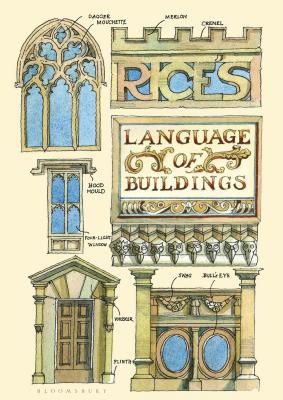
As Matthew Rice says, "Once you can speak any language, conversation can begin, but without it communications can only be brief and brutish. The same is the case with Architecture: an inability to describe the component parts of a building leaves one tongue-tied and unable to begin to discuss what is or is not exciting, dull or peculiar about it." The Language of Buildings will explain the language of architecture. With it in your hand, buildings will break down beguilingly into their component parts, ready for inspection and discussion. There will be no more references to that curly bit on top of the thing with the square protrusions. Ungainly and inept descriptions will be a thing of the past and, fluent in the world of volutes, hood moulds, lobed architraves and bucrania, you will be able to leave a cathedral or country house with as much to talk about as a film or play.

The Language of Buildings starts with an explanation of the basic "Grammar" of buildings: elevation, plan, roof, gable and eave. This will enable the reader to better make use of what is to follow. It will also cover the Orders of Architecture--Doric, Tuscan, Ionic, Corinthian and Composite--so that the vital basics of Classicism are covered. Following this is the "Vocabulary." This will be a chronological reference section covering, period by period, the windows, doors and doorcases, columns, chimneys, arches, balustrades and pediments that make up the built environment.

Shipping & returnsShipping options, delivery timing, and our return policy.

In-stock items normally dispatch within 1–2 business days. The ZIP-code estimator on this page is informational only; the final shipping method, price, and availability are confirmed at checkout for your full order.

For the initial delivery estimate we use these transit windows after dispatch: Standard 5–8 business days, Expedited 2–4 business days, and Priority 1–2 business days. Holiday delays are not included.

Eligible items can be returned within 30 days in accordance with our return policy.

Customer reviews