Home › Applied › Property-Preserving Numerical Schemes for Conservation Laws

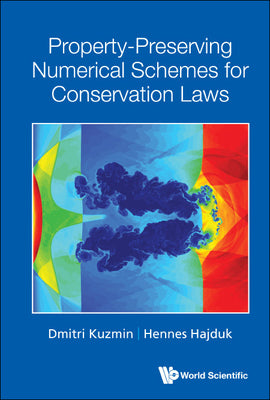
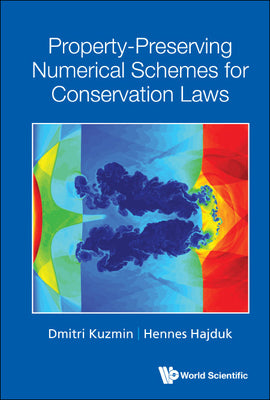
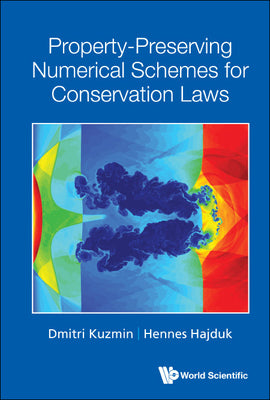
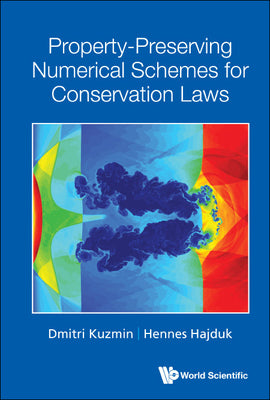
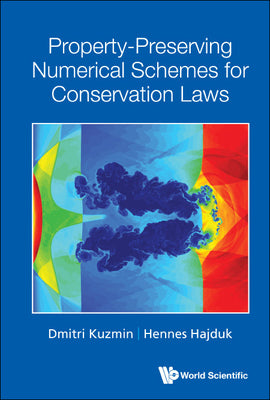
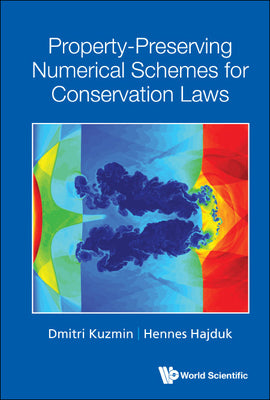
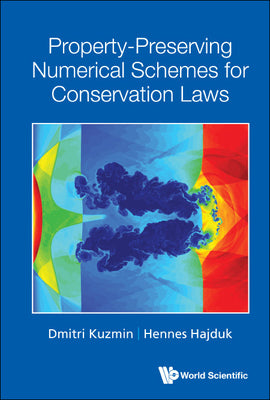
Property-Preserving Numerical Schemes for Conservation Laws

by Kuzmin Dmitri

Methods and theory for preserving constraints in numerical simulations

Regular price $180.48 USD
Regular price $200.54 USD Sale price $180.48 USD
Save 10%

Hardcover New English

Delivery to your door
In stock·Dispatches in 1–2 business days
Standard shipping* from $4.35
Standard shipping transit* 5–8 business days after dispatch

Faster options are available.

Rates and delivery estimates depend on your destination and item quantity. Estimates are informational only; the final shipping method and rate are selected at checkout.

Secure checkout
American Express Apple Pay DiscoverGoogle Pay Mastercard PayPalVisa
30-day eligible returns Returns & refunds policy

AlbakiReads Editorial

Methods and theory for preserving constraints in numerical simulations

This applied mathematics text examines how numerical schemes for hyperbolic conservation laws can preserve constraints such as discrete maximum principles and entropy inequalities. Its two-part structure moves from stabilization methods and limiting techniques across finite volume, continuous Galerkin, and discontinuous Galerkin approaches to the mathematical analysis of convergence and algebraic flux correction. Alongside ready-to-use algorithms, the book explains the design principles behind them, connecting practical implementation with the theory of property-preserving schemes.

Good fit for readers who enjoy

  • Advanced graduate students studying numerical methods for hyperbolic problems
  • Researchers developing or analyzing finite volume and finite element schemes
  • Readers seeking both algorithms and mathematical analysis of stabilization methods

Themes

Hyperbolic conservation lawsProperty-preserving numerical methodsFinite volume and finite element schemesNumerical stabilization and convergence theory

Based on publisher information and book metadata.

Book overview

High-order numerical methods for hyperbolic conservation laws do not guarantee the validity of constraints that physically meaningful approximations are supposed to satisfy. The finite volume and finite element schemes summarized in this book use limiting techniques to enforce discrete maximum principles and entropy inequalities. Spurious oscillations are prevented using artificial viscosity operators and/or essentially nonoscillatory reconstructions.


An introduction to classical nonlinear stabilization approaches is given in the simple context of one-dimensional finite volume discretizations. Subsequent chapters of Part I are focused on recent extensions to continuous and discontinuous Galerkin methods. Many of the algorithms presented in these chapters were developed by the authors and their collaborators. Part II gives a deeper insight into the mathematical theory of property-preserving numerical schemes. It begins with a review of the convergence theory for finite volume methods and ends with analysis of algebraic flux correction schemes for finite elements. In addition to providing ready-to-use algorithms, this text explains the design principles behind such algorithms and shows how to put theory into practice. Although the book is based on lecture notes written for an advanced graduate-level course, it is also aimed at senior researchers who develop and analyze numerical methods for hyperbolic problems.

Shipping & returnsShipping options, delivery timing, and our return policy.

In-stock items normally dispatch within 1–2 business days. The ZIP-code estimator on this page is informational only; the final shipping method, price, and availability are confirmed at checkout for your full order.

For the initial delivery estimate we use these transit windows after dispatch: Standard 5–8 business days, Expedited 2–4 business days, and Priority 1–2 business days. Holiday delays are not included.

Eligible items can be returned within 30 days in accordance with our return policy.

Customer reviews