Home › Hardcover Books › Group and Representation Theory

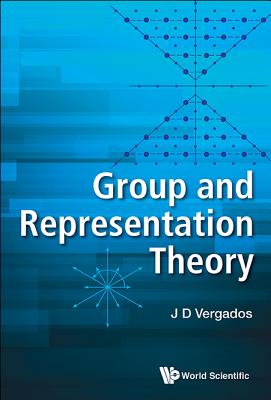
Group and Representation Theory

by Vergados J D

A physics-oriented guide to groups and representations

Regular price $95.12 USD
Regular price $105.69 USD Sale price $95.12 USD
Save 10%

Hardcover New English

Delivery to your door
In stock·Dispatches in 1–2 business days
Standard shipping* from $4.35
Standard shipping transit* 5–8 business days after dispatch

Faster options are available.

Rates and delivery estimates depend on your destination and item quantity. Estimates are informational only; the final shipping method and rate are selected at checkout.

Secure checkout
American Express Apple Pay DiscoverGoogle Pay Mastercard PayPalVisa
30-day eligible returns Returns & refunds policy

AlbakiReads Editorial

A physics-oriented guide to groups and representations

Vergados connects continuous symmetries and Lie algebras with the study of classical and quantum physical systems. The book develops classical Lie algebras and their representations through root systems, Dynkin diagrams, highest weights, and Young tableaux, including the relationship between these descriptions. It also treats subalgebras, products of irreducible representations, and methods for obtaining Clebsch–Gordan coefficients, with algorithms and numerical tables in some cases. Examples run through the discussion, while two appendices collect summary tables and results from more advanced examples, with pointers linking them to the main text.

Good fit for readers who enjoy

  • Physics students or practitioners seeking a treatment of symmetry and representation theory in physical systems.
  • Readers studying Lie algebras, highest-weight representations, or Young tableaux.
  • Those looking for worked examples, algorithms, and reference tables on Clebsch–Gordan coefficients.

Themes

Continuous symmetries in classical and quantum physicsLie algebras and their representationsRoot systems, weights, and Young tableauxSubalgebras and Clebsch–Gordan coefficients

Based on publisher information and book metadata.

Book overview

This volume goes beyond the understanding of symmetries and exploits them in the study of the behavior of both classical and quantum physical systems. Thus it is important to study the symmetries described by continuous (Lie) groups of transformations. We then discuss how we get operators that form a Lie algebra. Of particular interest to physics is the representation of the elements of the algebra and the group in terms of matrices and, in particular, the irreducible representations. These representations can be identified with physical observables.

This leads to the study of the classical Lie algebras, associated with unitary, unimodular, orthogonal and symplectic transformations. We also discuss some special algebras in some detail. The discussion proceeds along the lines of the Cartan-Weyl theory via the root vectors and root diagrams and, in particular, the Dynkin representation of the roots. Thus the representations are expressed in terms of weights, which are generated by the application of the elements of the algebra on uniquely specified highest weight states. Alternatively these representations can be described in terms of tensors labeled by the Young tableaux associated with the discrete symmetry Sn. The connection between the Young tableaux and the Dynkin weights is also discussed. It is also shown that in many physical systems the quantum numbers needed to specify the physical states involve not only the highest symmetry but also a number of sub-symmetries contained in them. This leads to the study of the role of subalgebras and in particular the possible maximal subalgebras. In many applications the physical system can be considered as composed of subsystems obeying a given symmetry. In such cases the reduction of the Kronecker product of irreducible representations of classical and special algebras becomes relevant and is discussed in some detail. The method of obtaining the relevant Clebsch-Gordan (C-G) coefficients for such algebras is discussed and some relevant algorithms are provided. In some simple cases suitable numerical tables of C-G are also included.

The above exposition contains many examples, both as illustrations of the main ideas as well as well motivated applications. To this end two appendices of 51 pages -- 11 tables in Appendix A, summarizing the material discussed in the main text and 39 tables in Appendix B containing results of more sophisticated examples are supplied. Reference to the tables is given in the main text and a guide to the appropriate section of the main text is given in the tables.

Shipping & returnsShipping options, delivery timing, and our return policy.

In-stock items normally dispatch within 1–2 business days. The ZIP-code estimator on this page is informational only; the final shipping method, price, and availability are confirmed at checkout for your full order.

For the initial delivery estimate we use these transit windows after dispatch: Standard 5–8 business days, Expedited 2–4 business days, and Priority 1–2 business days. Holiday delays are not included.

Eligible items can be returned within 30 days in accordance with our return policy.

Customer reviews