Home › Architecture › Becoming Jane Jacobs

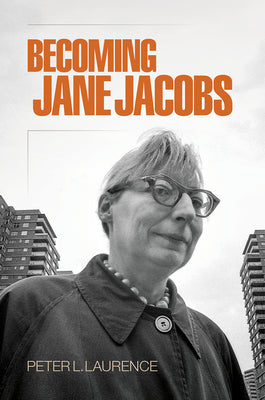
Becoming Jane Jacobs

by Peter L. Laurence

The intellectual formation of Jane Jacobs

Regular price $41.94 USD
Regular price $59.92 USD Sale price $41.94 USD
Save 30%

Paperback New English

Delivery to your door
In stock·Dispatches in 1–2 business days
Standard shipping* from $4.35
Standard shipping transit* 5–8 business days after dispatch

Faster options are available.

Rates and delivery estimates depend on your destination and item quantity. Estimates are informational only; the final shipping method and rate are selected at checkout.

Secure checkout
American Express Apple Pay DiscoverGoogle Pay Mastercard PayPalVisa
30-day eligible returns Returns & refunds policy

AlbakiReads Editorial

The intellectual formation of Jane Jacobs

The familiar account of Jane Jacobs emphasizes her observations of city life and her opposition to urban renewal. Peter L. Laurence looks further back, tracing the professional work and intellectual exchanges behind her ideas. This biography places Jacobs among the architects, planners, editors, and writers whose thinking she encountered and often challenged. It also connects the development of *The Death and Life of Great American Cities* to her longer writing career, presenting her critique of urban renewal as the work of an experienced architectural critic, not a sudden insight from outside the field.

Good fit for readers who enjoy

  • Readers interested in Jane Jacobs’s intellectual development
  • Architecture and urban-planning readers exploring the history of urban renewal
  • Readers seeking context for *The Death and Life of Great American Cities*

Themes

Intellectual biographyUrban renewalArchitectural criticismIdeas about city life

Based on publisher information and book metadata.

Book overview

Jane Jacobs is universally recognized as one of the key figures in American urbanism. The author of The Death and Life of Great American Cities, she uncovered the complex and intertwined physical and social fabric of the city and excoriated the urban renewal policies of the 1950s. As the legend goes, Jacobs, a housewife, single-handedly stood up to Robert Moses, New York City's powerful master builder, and other city planners who sought first to level her Greenwich Village neighborhood and then to drive a highway through it. Jacobs's most effective weapons in these David-versus-Goliath battles, and in writing her book, were her powers of observation and common sense.

What is missing from such discussions and other myths about Jacobs, according to Peter L. Laurence, is a critical examination of how she arrived at her ideas about city life. Laurence shows that although Jacobs had only a high school diploma, she was nevertheless immersed in an elite intellectual community of architects and urbanists. Becoming Jane Jacobs is an intellectual biography that chronicles Jacobs's development, influences, and writing career, and provides a new foundation for understanding Death and Life and her subsequent books. Laurence explains how Jacobs's ideas developed over many decades and how she was influenced by members of the traditions she was critiquing, including Architectural Forum editor Douglas Haskell, shopping mall designer Victor Gruen, housing advocate Catherine Bauer, architect Louis Kahn, Philadelphia city planner Edmund Bacon, urban historian Lewis Mumford, and the British writers at The Architectural Review. Rather than discount the power of Jacobs's critique or contributions, Laurence asserts that Death and Life was not the spontaneous epiphany of an amateur activist but the product of a professional writer and experienced architectural critic with deep knowledge about the renewal and dynamics of American cities.

Shipping & returnsShipping options, delivery timing, and our return policy.

In-stock items normally dispatch within 1–2 business days. The ZIP-code estimator on this page is informational only; the final shipping method, price, and availability are confirmed at checkout for your full order.

For the initial delivery estimate we use these transit windows after dispatch: Standard 5–8 business days, Expedited 2–4 business days, and Priority 1–2 business days. Holiday delays are not included.

Eligible items can be returned within 30 days in accordance with our return policy.

Customer reviews