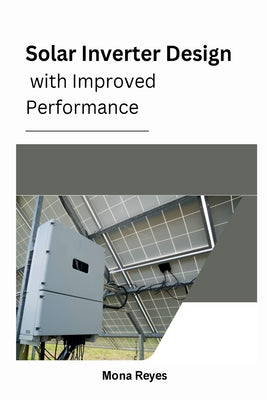
Home › Science › Solar Inverter Design with Improved Performance

Solar Inverter Design with Improved Performance

by Mona Reyes

A technical overview of solar inverter design

Regular price $38.34 USD
Regular price $47.93 USD Sale price $38.34 USD
Save 20%

Paperback New

Delivery to your door
In stock·Dispatches in 1–2 business days
Standard shipping* from $4.35
Standard shipping transit* 5–8 business days after dispatch

Faster options are available.

Rates and delivery estimates depend on your destination and item quantity. Estimates are informational only; the final shipping method and rate are selected at checkout.

Secure checkout
American Express Apple Pay DiscoverGoogle Pay Mastercard PayPalVisa
30-day eligible returns Returns & refunds policy

AlbakiReads Editorial

A technical overview of solar inverter design

Mona Reyes’s article examines solar photovoltaic-fed modular multilevel inverters through the engineering questions involved in their design and operation. Topics include power conversion and conditioning, MPPT, voltage and current regulation, harmonic distortion, and power-factor correction. It also surveys control approaches—from hysteresis and sliding-mode control to fuzzy logic, neural networks, and artificial intelligence—and describes the use of simulation models to analyze performance. The discussion places inverter design within broader renewable-energy systems, including grid-connected, stand-alone, and microgrid configurations, as well as links to battery storage and smart grids. Circuit design, optimization, switching control, and power-system stability round out this technical scope.

Good fit for readers who enjoy

  • Readers studying power electronics, electrical engineering, or solar photovoltaic systems.
  • Readers seeking an overview of inverter control methods and performance considerations.
  • Readers interested in how solar inverters connect with storage, microgrids, and smart grids.

Themes

Solar photovoltaic invertersPower electronics and controlRenewable-energy integrationEnergy storage and grid stability

Based on publisher information and book metadata.

Book overview

The article titled "Solar Inverter Design with Improved Performance" Mona Reyes discusses the design and development of a solar photovoltaic-fed modular multilevel inverter that offers improved power quality and efficiency. The paper explores the various aspects of solar inverters, including power electronics, power conditioning, and power conversion. The author delves into the key issues that need to be addressed to improve the performance of solar inverters, such as maximum power point tracking (MPPT), voltage and current regulation, reactive power compensation, harmonic distortion, power factor correction, and pulse width modulation (PWM). The article also discusses various control methods, such as hysteresis control, sliding mode control, fuzzy logic control, neural networks, and artificial intelligence, that can be used to optimize the performance of solar inverters. Furthermore, the paper highlights the importance of circuit design and electrical engineering in designing solar inverters, and explains how optimization techniques can be used to improve their performance. The article also covers various types of renewable energy systems, including grid-connected systems, stand-alone systems, and microgrid systems, and explores how solar inverters can be integrated with energy storage systems and battery systems to provide a more stable and reliable power supply. Additionally, the article discusses the role of solar inverters in smart grid systems and provides an overview of power control and switching control. The author uses simulation models to analyze the performance of solar inverters and highlights the importance of power system stability and control for efficient and reliable power supply.

Shipping & returnsShipping options, delivery timing, and our return policy.

In-stock items normally dispatch within 1–2 business days. The ZIP-code estimator on this page is informational only; the final shipping method, price, and availability are confirmed at checkout for your full order.

For the initial delivery estimate we use these transit windows after dispatch: Standard 5–8 business days, Expedited 2–4 business days, and Priority 1–2 business days. Holiday delays are not included.

Eligible items can be returned within 30 days in accordance with our return policy.

Customer reviews