Home › Architecture › Monumentality in Etruscan and Early Roman Architecture: Ideology and Innovation

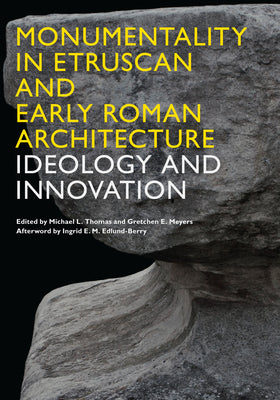
Monumentality in Etruscan and Early Roman Architecture: Ideology and Innovation

by Michael L. Thomas

How monumentality took shape in early Italy

Regular price $35.18 USD
Regular price $35.18 USD Sale price $35.18 USD

Paperback New English

Delivery to your door
In stock·Dispatches in 1–2 business days
Standard shipping* from $4.35
Standard shipping transit* 5–8 business days after dispatch

Faster options are available.

Rates and delivery estimates depend on your destination and item quantity. Estimates are informational only; the final shipping method and rate are selected at checkout.

Secure checkout
American Express Apple Pay DiscoverGoogle Pay Mastercard PayPalVisa
30-day eligible returns Returns & refunds policy

AlbakiReads Editorial

How monumentality took shape in early Italy

This edited collection examines how Etruscan and early Roman architecture came to use scale as a defining feature before the height of Imperial Roman building. Its contributors consider commemoration, durability, and visibility alongside the technical aspects of construction, linking architectural choices to the social and political strategies of ruling elites. The essays approach the subject from multiple viewpoints and disciplines, framing monumentality not simply as a matter of size but as an architectural and ideological development in ancient Italy.

Good fit for readers who enjoy

  • Readers interested in Etruscan and early Roman architecture and its historical development.
  • Students and scholars exploring ancient architecture through social, political, and technical perspectives.
  • Readers curious about how buildings can express commemoration, durability, and visibility.

Themes

Monumentality and architectural scaleEtruscan and early Roman architectureArchitecture, ideology, and elite powerCommemoration, durability, and visibility

Based on publisher information and book metadata.

Book overview

Every society builds, and many, if not all, utilize architectural structures as markers to define place, patron, or experience. Often we consider these architectural markers as "monuments" or "monumental" buildings. Ancient Rome, in particular, is a society recognized for the monumentality of its buildings. While few would deny that the term "monumental" is appropriate for ancient Roman architecture, the nature of this characterization and its development in pre-Roman Italy is rarely considered carefully. What is "monumental" about Etruscan and early Roman architecture?

Delving into the crucial period before the zenith of Imperial Roman building, Monumentality in Etruscan and Early Roman Architecture addresses such questions as, "What factors drove the emergence of scale as a defining element of ancient Italian architecture?" and "How did monumentality arise as a key feature of Roman architecture?" Contributors Elizabeth Colantoni, Anthony Tuck, Nancy A. Winter, P. Gregory Warden, John N. Hopkins, Penelope J. E. Davies, and Ingrid Edlund-Berry reflect on the ways in which ancient Etruscans and Romans utilized the concepts of commemoration, durability, and visibility to achieve monumentality. The editors' preface and introduction underscore the notion of architectural evolution toward monumentality as being connected to the changing social and political strategies of the ruling elites.

By also considering technical components, this collection emphasizes the development and the ideological significance of Etruscan and early Roman monumentality from a variety of viewpoints and disciplines. The result is a broad range of interpretations celebrating both ancient and modern perspectives.

Shipping & returnsShipping options, delivery timing, and our return policy.

In-stock items normally dispatch within 1–2 business days. The ZIP-code estimator on this page is informational only; the final shipping method, price, and availability are confirmed at checkout for your full order.

For the initial delivery estimate we use these transit windows after dispatch: Standard 5–8 business days, Expedited 2–4 business days, and Priority 1–2 business days. Holiday delays are not included.

Eligible items can be returned within 30 days in accordance with our return policy.

Customer reviews