Home › 19th Century › Manet's Ironic Duplicity: Hamlet, Baudelaire, and Masculinity (B&W)

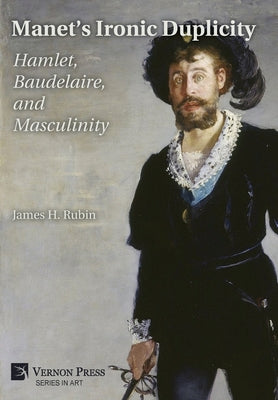
Manet's Ironic Duplicity: Hamlet, Baudelaire, and Masculinity (B&W)

by James H. Rubin

Manet through irony, identity, and performance

Regular price $80.66 USD
Regular price $100.83 USD Sale price $80.66 USD
Save 20%

Hardcover New

Delivery to your door
In stock·Dispatches in 1–2 business days
Standard shipping* from $4.35
Standard shipping transit* 5–8 business days after dispatch

Faster options are available.

Rates and delivery estimates depend on your destination and item quantity. Estimates are informational only; the final shipping method and rate are selected at checkout.

Secure checkout
American Express Apple Pay DiscoverGoogle Pay Mastercard PayPalVisa
30-day eligible returns Returns & refunds policy

AlbakiReads Editorial

Manet through irony, identity, and performance

James H. Rubin organizes this study of Édouard Manet around duplicity and irony, connecting the painter’s work to the political pressures, censorship, and questions of masculinity that shaped his struggle for authenticity. Instead of tracing Manet’s career chronologically, the book builds an interdisciplinary argument through key concepts. Its framework brings Charles Baudelaire’s writing on laughter and the comic arts into discussion of Manet’s irony, while two representations of Hamlet serve as the analysis’s starting and closing points. The final section turns to Manet’s illustrated letters to women, interpreting them in relation to his concealment of his fatal illness and his sense of masculine honor.

Good fit for readers who enjoy

  • Readers interested in nineteenth-century art history and Manet scholarship.
  • Those exploring connections between visual art, literature, theatre, and Baudelaire.
  • Readers interested in masculinity, censorship, and political context in art.

Themes

Irony and duplicityMasculinity and artistic identityArt, politics, and censorshipManet, Baudelaire, and theatre

Based on publisher information and book metadata.

Book overview

The painter Edouard Manet (1832-1883) was a central figure for momentous and lasting changes in the realm of art that still resound today. His art speaks directly to the philosophical issues and political conflicts of his own time and is therefore deeply embedded in the development of modernity. 'Manet's Ironic Duplicity' focuses on that situation and the historically conscious artist's sometimes ambivalent struggle for authenticity. Rather than another full chronological monograph, the book is an interdisciplinary study organized around key concepts. It reframes the major, and sometimes disparate issues in Manet scholarship by focusing on a never-before-considered overriding theme-duplicity-which itself is multiple in its manifestations and variants, hence 'duplicities'. Reversing the usual narrative, this study deconstructs and enlightens the myth of the heroic artist struggling for individual and original vision by revealing how so much of Manet's creativity and irony was prompted by frustrations due to repressive politics, censorship, and challenges to his sense of self. A key aspect of the latter was his masculinity.

Although Manet's association with the ideas of the poet and critic Charles Baudelaire is well known, never has Baudelaire's essay 'On the Essence of Laughter and the Comic in the Visual Arts' been brought to bear on the concept of irony in Manet's work. Given Baudelaire's rapprochement between actors and artists, as well as Manet's familiarity with the theatrical milieu, the book focuses on Manet's two little-studied representations of 'Hamlet' as both the starting and end point of its analysis. It then concludes with a re-reading of the painter's illustrated letters to women as a dissimulation of his final, fatal illness in order to maintain his masculine honor.

Shipping & returnsShipping options, delivery timing, and our return policy.

In-stock items normally dispatch within 1–2 business days. The ZIP-code estimator on this page is informational only; the final shipping method, price, and availability are confirmed at checkout for your full order.

For the initial delivery estimate we use these transit windows after dispatch: Standard 5–8 business days, Expedited 2–4 business days, and Priority 1–2 business days. Holiday delays are not included.

Eligible items can be returned within 30 days in accordance with our return policy.

Customer reviews