Home › Language Arts & Disciplines › Irony and Sarcasm

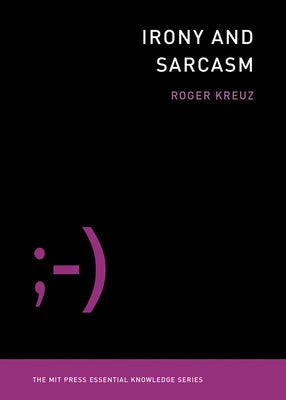
Irony and Sarcasm

by Roger Kreuz

Tracing two often-confused terms

Regular price $15.21 USD
Regular price $25.35 USD Sale price $15.21 USD
Save 40%

Paperback New

Delivery to your door
In stock·Dispatches in 1–2 business days
Standard shipping* from $4.35
Standard shipping transit* 5–8 business days after dispatch

Faster options are available.

Rates and delivery estimates depend on your destination and item quantity. Estimates are informational only; the final shipping method and rate are selected at checkout.

Secure checkout
American Express Apple Pay DiscoverGoogle Pay Mastercard PayPalVisa
30-day eligible returns Returns & refunds policy

AlbakiReads Editorial

Tracing two often-confused terms

Roger Kreuz’s concise overview follows irony and sarcasm across a long history, from Greek philosophy and Roman rhetoric to literary criticism and online communication. It distinguishes verbal irony from sarcasm, which the book presents as one form of verbal irony, and maps eight uses of irony, including Socratic, dramatic, and cosmic. Along the way, Kreuz addresses what irony is not, the shared context that can help make it legible, and the signals people use to convey ironic intent. The discussion also considers why irony can be difficult to recognize online and whether the word itself may gradually give way to “sarcasm.”

Good fit for readers who enjoy

  • Readers interested in the meanings and history of everyday language.
  • Those exploring irony, sarcasm, and how context shapes interpretation.
  • Readers seeking a concise introduction to linguistic and rhetorical concepts.

Themes

History of languageIrony and sarcasmContext and interpretationOnline communication

Based on publisher information and book metadata.

Book overview

A biography of two troublesome words.

Isn't it ironic? Or is it? Never mind, I'm just being sarcastic (or am I?). Irony and sarcasm are two of the most misused, misapplied, and misunderstood words in our conversational lexicon. In this volume in the MIT Press Essential Knowledge series, psycholinguist Roger Kreuz offers an enlightening and concise overview of the life and times of these two terms, mapping their evolution from Greek philosophy and Roman rhetoric to modern literary criticism to emojis.

Kreuz describes eight different ways that irony has been used through the centuries, proceeding from Socratic to dramatic to cosmic irony. He explains that verbal irony--irony as it is traditionally understood--refers to statements that mean something different (frequently the opposite) of what is literally intended, and defines sarcasm as a type of verbal irony. Kreuz outlines the prerequisites for irony and sarcasm (one of which is a shared frame of reference); clarifies what irony is not (coincidence, paradox, satire) and what it can be (among other things, a socially acceptable way to express hostility); recounts ways that people can signal their ironic intentions; and considers the difficulties of online irony. Finally, he wonders if, because irony refers to so many different phenomena, people may gradually stop using the word, with sarcasm taking over its verbal duties.

Shipping & returnsShipping options, delivery timing, and our return policy.

In-stock items normally dispatch within 1–2 business days. The ZIP-code estimator on this page is informational only; the final shipping method, price, and availability are confirmed at checkout for your full order.

For the initial delivery estimate we use these transit windows after dispatch: Standard 5–8 business days, Expedited 2–4 business days, and Priority 1–2 business days. Holiday delays are not included.

Eligible items can be returned within 30 days in accordance with our return policy.

Customer reviews