Home › Demography › iGen: Why Today's Super-Connected Kids Are Growing Up Less Rebellious, More Tolerant, Less Happy--And Completely Unprepared for Adulthood--And What Th

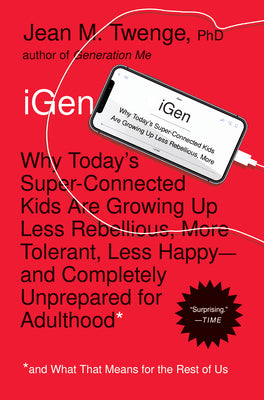
iGen: Why Today's Super-Connected Kids Are Growing Up Less Rebellious, More Tolerant, Less Happy--And Completely Unprepared for Adulthood--And What Th

by Jean M. Twenge

A portrait of a generation shaped by smartphones

Regular price $17.72 USD
Regular price $29.54 USD Sale price $17.72 USD
Save 40%

Paperback New

Delivery to your door
In stock·Dispatches in 1–2 business days
Standard shipping* from $4.35
Standard shipping transit* 5–8 business days after dispatch

Faster options are available.

Rates and delivery estimates depend on your destination and item quantity. Estimates are informational only; the final shipping method and rate are selected at checkout.

Secure checkout
American Express Apple Pay DiscoverGoogle Pay Mastercard PayPalVisa
30-day eligible returns Returns & refunds policy

AlbakiReads Editorial

A portrait of a generation shaped by smartphones

Jean M. Twenge examines young people born from the mid-1990s through the mid-2000s, whose adolescence coincided with the rise of smartphones and social media. The book connects changes in how they socialize and spend their time with broader questions about anxiety, loneliness, and well-being, while also considering their attitudes toward religion, sexuality, politics, safety, and inequality. Its scope extends beyond family life to education and work, framing generational differences as relevant to how young adults communicate with older generations and how institutions respond to them. The book presents a broad social portrait, with technology as one part of a wider account of changing behavior and priorities.

Good fit for readers who enjoy

  • Parents, educators, and employers seeking context on young adults’ experiences and priorities.
  • Readers interested in generational differences, social media, and youth well-being.
  • Young adults interested in how their generation is described in relation to older generations.

Themes

Generational changeSmartphones and social mediaYouth well-beingAttitudes toward safety, tolerance, and inequalityEducation and work

Based on publisher information and book metadata.

Book overview

As seen in Time, USA TODAY, The Atlantic, The Wall Street Journal, and on CBS This Morning, BBC, PBS, CNN, and NPR, iGen is crucial reading to understand how the children, teens, and young adults born in the mid-1990s and later are vastly different from their Millennial predecessors, and from any other generation.With generational divides wider than ever, parents, educators, and employers have an urgent need to understand today's rising generation of teens and young adults. Born in the mid-1990s up to the mid-2000s, iGen is the first generation to spend their entire adolescence in the age of the smartphone. With social media and texting replacing other activities, iGen spends less time with their friends in person--perhaps contributing to their unprecedented levels of anxiety, depression, and loneliness. But technology is not the only thing that makes iGen distinct from every generation before them; they are also different in how they spend their time, how they behave, and in their attitudes toward religion, sexuality, and politics. They socialize in completely new ways, reject once sacred social taboos, and want different things from their lives and careers. More than previous generations, they are obsessed with safety, focused on tolerance, and have no patience for inequality. With the first members of iGen just graduating from college, we all need to understand them: friends and family need to look out for them; businesses must figure out how to recruit them and sell to them; colleges and universities must know how to educate and guide them. And members of iGen also need to understand themselves as they communicate with their elders and explain their views to their older peers. Because where iGen goes, so goes our nation--and the world.
Shipping & returnsShipping options, delivery timing, and our return policy.

In-stock items normally dispatch within 1–2 business days. The ZIP-code estimator on this page is informational only; the final shipping method, price, and availability are confirmed at checkout for your full order.

For the initial delivery estimate we use these transit windows after dispatch: Standard 5–8 business days, Expedited 2–4 business days, and Priority 1–2 business days. Holiday delays are not included.

Eligible items can be returned within 30 days in accordance with our return policy.

Customer reviews