Home › African American & Black › How the Word Is Passed: A Reckoning with the History of Slavery Across America

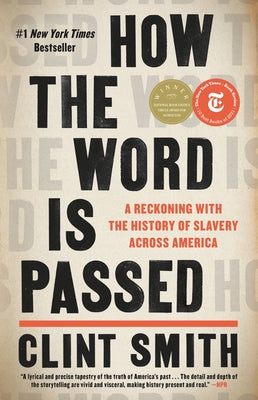
How the Word Is Passed: A Reckoning with the History of Slavery Across America

by Clint Smith

Landmarks as records of slavery and memory

Regular price $23.90 USD
Regular price $39.84 USD Sale price $23.90 USD
Save 40%

Hardcover New

Format

Print BookCurrently viewing Hardcover $23.90 USD$39.84 USD
Print BookAvailable Paperback $18.95 USD$31.59 USD
Delivery to your door
In stock·Dispatches in 1–2 business days
Standard shipping* from $4.35
Standard shipping transit* 5–8 business days after dispatch

Faster options are available.

Rates and delivery estimates depend on your destination and item quantity. Estimates are informational only; the final shipping method and rate are selected at checkout.

Secure checkout
American Express Apple Pay DiscoverGoogle Pay Mastercard PayPalVisa
30-day eligible returns Returns & refunds policy

Awards & Recognition

  • Award recognition

    Winner of the National Book Critics Circle Award for Nonfiction

    The source states that the book won this award.

  • Bestseller

    #1 New York Times bestseller

    Source describes the book as a #1 New York Times bestseller.

  • Editorial selection

    A New York Times 10 Best Book of 2021

    Included among the New York Times' 10 Best Books of 2021.

AlbakiReads Editorial

Landmarks as records of slavery and memory

Clint Smith examines how slavery’s history is preserved, obscured, and carried into the present through visits to sites across the United States. The places include Monticello and the Whitney Plantation in Virginia and Louisiana, Angola prison, Blandford Cemetery, and parts of downtown Manhattan; the book also considers Juneteenth as a site of public memory. Moving between these locations and the lives of people connected to them, Smith links physical landmarks to the stories Americans tell—or leave untold—about slavery. The book’s central thread is the relationship between historical remembrance and contemporary life, with each place offering a different way to consider slavery’s enduring imprint on the country.

Good fit for readers who enjoy

  • For readers of U.S. history focused on slavery and its legacy.
  • For those interested in monuments, historic sites, and public memory.
  • For readers exploring how the past shapes contemporary American life.

Themes

Slavery and its legacyHistorical memoryMonuments and landmarksPublic historyRace and American identity

Based on publisher information and book metadata.

Book overview

This "important and timely" (Drew Faust, Harvard Magazine) #1 New York Times bestseller examines the legacy of slavery in America--and how both history and memory continue to shape our everyday lives.

Beginning in his hometown of New Orleans, Clint Smith leads the reader on an unforgettable tour of monuments and landmarks--those that are honest about the past and those that are not--that offer an intergenerational story of how slavery has been central in shaping our nation's collective history, and ourselves.

It is the story of the Monticello Plantation in Virginia, the estate where Thomas Jefferson wrote letters espousing the urgent need for liberty while enslaving more than four hundred people. It is the story of the Whitney Plantation, one of the only former plantations devoted to preserving the experience of the enslaved people whose lives and work sustained it. It is the story of Angola, a former plantation-turned-maximum-security prison in Louisiana that is filled with Black men who work across the 18,000-acre land for virtually no pay. And it is the story of Blandford Cemetery, the final resting place of tens of thousands of Confederate soldiers.

A deeply researched and transporting exploration of the legacy of slavery and its imprint on centuries of American history, How the Word Is Passed illustrates how some of our country's most essential stories are hidden in plain view--whether in places we might drive by on our way to work, holidays such as Juneteenth, or entire neighborhoods like downtown Manhattan, where the brutal history of the trade in enslaved men, women, and children has been deeply imprinted.

Informed by scholarship and brought to life by the story of people living today, Smith's debut work of nonfiction is a landmark of reflection and insight that offers a new understanding of the hopeful role that memory and history can play in making sense of our country and how it has come to be.


Winner of the National Book Critics Circle Award for Nonfiction

Winner of the Stowe Prize

Winner of 2022 Hillman Prize for Book Journalism

A New York Times 10 Best Books of 2021

Shipping & returnsShipping options, delivery timing, and our return policy.

In-stock items normally dispatch within 1–2 business days. The ZIP-code estimator on this page is informational only; the final shipping method, price, and availability are confirmed at checkout for your full order.

For the initial delivery estimate we use these transit windows after dispatch: Standard 5–8 business days, Expedited 2–4 business days, and Priority 1–2 business days. Holiday delays are not included.

Eligible items can be returned within 30 days in accordance with our return policy.

Customer reviews