Home › Hardcover Books › The Good Jobs Strategy: How the Smartest Companies Invest in Employees to Lower Costs and Boost Profits

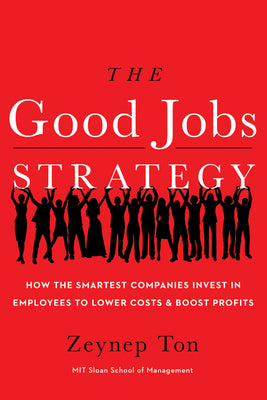
The Good Jobs Strategy: How the Smartest Companies Invest in Employees to Lower Costs and Boost Profits

by Zeynep Ton

A business case for investing in frontline workers

Regular price $22.05 USD
Regular price $36.75 USD Sale price $22.05 USD
Save 40%

Hardcover New

Delivery to your door
In stock·Dispatches in 1–2 business days
Standard shipping* from $4.35
Standard shipping transit* 5–8 business days after dispatch

Faster options are available.

Rates and delivery estimates depend on your destination and item quantity. Estimates are informational only; the final shipping method and rate are selected at checkout.

Secure checkout
American Express Apple Pay DiscoverGoogle Pay Mastercard PayPalVisa
30-day eligible returns Returns & refunds policy

AlbakiReads Editorial

A business case for investing in frontline workers

Zeynep Ton examines the link between job quality and operational performance, challenging the idea that low prices depend on low wages, limited training, and unstable schedules. Drawing on research and examples from companies including Southwest Airlines, Toyota, Costco, and Trader Joe’s, she sets out a strategy that connects investment in employees with cost control, customer satisfaction, and investor returns. Four retailers serve as central case studies, illustrating choices around product selection, staffing, work standards, and employee autonomy. The book frames labor practices not only as a matter of compensation, but as part of how organizations design and sustain their operations.

Good fit for readers who enjoy

  • Business readers interested in labor, wages, and compensation
  • Managers and organizational leaders exploring frontline operations and employee investment
  • Readers seeking company case studies on balancing costs, customer experience, and working conditions

Themes

Job quality and compensationOperational excellenceEmployee investmentRetail strategyCustomer satisfaction and profitability

Based on publisher information and book metadata.

Book overview

Almost one in four American working adults has a job that pays less than a living wage. Conven­tional wisdom says that's how the world has to work. Bad jobs with low wages, minimal benefits, little training, and chaotic schedules are the only way companies can keep costs down and prices low. If companies were to offer better jobs, cus­tomers would have to pay more or companies would have to make less.

But in The Good Jobs Strategy, Zeynep Ton, a professor at the MIT Sloan School of Management, makes the compelling case that even in low-cost settings, leaving employees behind--with bad jobs--is a choice, not a necessity. Drawing on more than a decade of research, Ton shows how operational excellence enables companies to of­fer the lowest prices to customers while ensuring good jobs for their employees and superior results for their investors.

Ton describes the elements of the good jobs strategy in a variety of successful companies around the world, including Southwest Airlines, UPS, Toyota, Zappos, and In-N-Out Burger. She focuses on four model retailers--Costco, Merca­dona, Trader Joe's, and QuikTrip--to demonstrate the good jobs strategy at work and reveals four choices that have transformed these compa­nies' high investment in workers into lower costs, higher profits, and greater customer sat­isfaction.

Full of surprising, counterintuitive insights, the book answers questions such as: How can offering fewer products increase customer sat­isfaction? Why would having more employees than you need reduce costs and boost profits? How can companies simultaneously standardize work and empower employees?

The Good Jobs Strategy outlines an invaluable blueprint for any organization that wants to pur­sue a sustainable competitive strategy in which everyone--employees, customers, and investors--wins.

Shipping & returnsShipping options, delivery timing, and our return policy.

In-stock items normally dispatch within 1–2 business days. The ZIP-code estimator on this page is informational only; the final shipping method, price, and availability are confirmed at checkout for your full order.

For the initial delivery estimate we use these transit windows after dispatch: Standard 5–8 business days, Expedited 2–4 business days, and Priority 1–2 business days. Holiday delays are not included.

Eligible items can be returned within 30 days in accordance with our return policy.

Customer reviews