Home › Business & Economics › Good to Great: Why Some Companies Make the Leap...and Others Don't

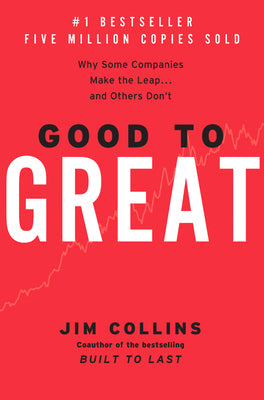
Good to Great: Why Some Companies Make the Leap...and Others Don't

by Jim Collins Publisher: HARPERCOLLINS

How companies move from good to great

Regular price $28.03 USD
Regular price $46.72 USD Sale price $28.03 USD
Save 40%

Hardcover New English

In stock · Dispatches in 1–2 business days
Delivery to your door
In stock·Dispatches in 1–2 business days
Standard shipping* from $4.35
Standard shipping transit* 5–8 business days after dispatch

Faster options are available.

Rates and delivery estimates depend on your destination and item quantity. Estimates are informational only; the final shipping method and rate are selected at checkout.

Secure checkout
American Express Apple Pay DiscoverGoogle Pay Mastercard PayPalVisa
30-day eligible returns Returns & refunds policy

AlbakiReads Editorial

How companies move from good to great

Jim Collins frames the book as a comparative study of companies that sustained exceptional performance and others that did not make the same leap. Drawing on a five-year analysis of 28 companies, the research examines leadership, organizational discipline, strategy, technology, and approaches to change. Its named concepts—including Level 5 Leadership, the Hedgehog Concept, and the Flywheel—organize a broad inquiry into what distinguished the two groups. The book presents these findings as a challenge to familiar assumptions about management, with an emphasis on patterns linked to enduring company performance.

Good fit for readers who enjoy

  • Business leaders and managers interested in organizational performance
  • Readers exploring leadership, management strategy, and company culture
  • Those interested in research-based comparisons of business performance

Themes

LeadershipOrganizational culture and disciplineBusiness strategyTechnology and changeSustained company performance

Based on publisher information and book metadata.

Book overview

The Challenge
Built to Last, the defining management study of the nineties, showed how great companies triumph over time and how long-term sustained performance can be engineered into the DNA of an enterprise from the very beginning.

But what about the company that is not born with great DNA? How can good companies, mediocre companies, even bad companies achieve enduring greatness?

The Study
For years, this question preyed on the mind of Jim Collins. Are there companies that defy gravity and convert long-term mediocrity or worse into long-term superiority? And if so, what are the universal distinguishing characteristics that cause a company to go from good to great?

The Standards
Using tough benchmarks, Collins and his research team identified a set of elite companies that made the leap to great results and sustained those results for at least fifteen years. How great? After the leap, the good-to-great companies generated cumulative stock returns that beat the general stock market by an average of seven times in fifteen years, better than twice the results delivered by a composite index of the world's greatest companies, including Coca-Cola, Intel, General Electric, and Merck.

The Comparisons
The research team contrasted the good-to-great companies with a carefully selected set of comparison companies that failed to make the leap from good to great. What was different? Why did one set of companies become truly great performers while the other set remained only good?

Over five years, the team analyzed the histories of all twenty-eight companies in the study. After sifting through mountains of data and thousands of pages of interviews, Collins and his crew discovered the key determinants of greatness -- why some companies make the leap and others don't.

The Findings
The findings of the Good to Great study will surprise many readers and shed light on virtually every area of management strategy and practice. The findings include:

  • Level 5 Leaders: The research team was shocked to discover the type of leadership required to achieve greatness.
  • The Hedgehog Concept (Simplicity within the Three Circles): To go from good to great requires transcending the curse of competence.
  • A Culture of Discipline: When you combine a culture of discipline with an ethic of entrepreneurship, you get the magical alchemy of great results. Technology Accelerators: Good-to-great companies think differently about the role of technology.
  • The Flywheel and the Doom Loop: Those who launch radical change programs and wrenching restructurings will almost certainly fail to make the leap.

"Some of the key concepts discerned in the study," comments Jim Collins, "fly in the face of our modern business culture and will, quite frankly, upset some people."

Perhaps, but who can afford to ignore these findings?

Shipping & returnsShipping options, delivery timing, and our return policy.

In-stock items normally dispatch within 1–2 business days. The ZIP-code estimator on this page is informational only; the final shipping method, price, and availability are confirmed at checkout for your full order.

For the initial delivery estimate we use these transit windows after dispatch: Standard 5–8 business days, Expedited 2–4 business days, and Priority 1–2 business days. Holiday delays are not included.

Eligible items can be returned within 30 days in accordance with our return policy.

Customer reviews

M
AlbakiReads
Malaika Taylor

I highly recommend to for anyone looking for inner clarity

T
AlbakiReads
Thomas DiMassa

Great service and fast service

Great shopping experience! The book arrived quickly, was well packaged, and matched the description perfectly. I would definitely shop with you again

O
AlbakiReads
Olivia

Smooth.