Home › Science › Feasibility Study of A Satellite Solar Power Station

Feasibility Study of A Satellite Solar Power Station

by NASA

A 1974 study of solar power from orbit

Regular price $38.33 USD
Regular price $47.92 USD Sale price $38.33 USD
Save 20%

Paperback New

Delivery to your door
In stock·Dispatches in 1–2 business days
Standard shipping* from $4.35
Standard shipping transit* 5–8 business days after dispatch

Faster options are available.

Rates and delivery estimates depend on your destination and item quantity. Estimates are informational only; the final shipping method and rate are selected at checkout.

Secure checkout
American Express Apple Pay DiscoverGoogle Pay Mastercard PayPalVisa
30-day eligible returns Returns & refunds policy

AlbakiReads Editorial

A 1974 study of solar power from orbit

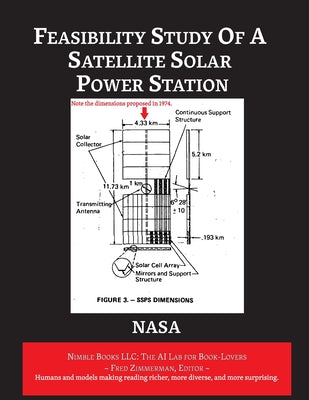
This NASA feasibility report examines a proposed satellite solar power station through the practical questions its design raised: how it might operate and be controlled in orbit, how to limit radio-frequency interference, and what environmental, technical, and economic issues would need attention. Its scope ranges from structural analysis and flight control to microwave transmission, energy conversion, biological effects, and costs and benefits. The 2024 annotated edition adds layered summaries, action items, viewpoint essays, notable passages, and page-by-page nutshell summaries, giving readers several entry points into the original report. The publisher’s framing connects the historical proposal to present-day energy concerns; the core document remains a technical assessment conducted in 1974.

Good fit for readers who enjoy

  • Readers interested in space-based solar power concepts and their engineering questions
  • Those exploring historical approaches to energy technology and environmental concerns
  • Readers who value layered summaries and supplementary commentary alongside a technical report

Themes

Satellite solar powerSpacecraft engineering and orbital controlRadio-frequency interferenceEnvironmental and biological impactsEnergy economics

Based on publisher information and book metadata.

Book overview

In a world grappling with climate change and escalating energy demands, this 1974 report for NASA organized by the consulting firm Arthur Little already presented this visionary solution: the Satellite Solar Power Station. By harnessing the limitless power of the sun, this technology offers a path towards clean, sustainable energy for generations to come. Fifty years later, we're still pumping greenhouse gases into the atmosphere. Read this report and wonder why.


From the 1974 abstract by the authors:


A feasibility study of a satellite solar power station (SSPS) was conducted to (1) explore how an SSPS could be "flown" and controlled in orbit; (2) determine the techniques needed to avoid radio* frequency interference (RFI); and (3) determine the key environmental, technological, and economic issues involved. Structural and dynamic analyses of the SSPS structure were performed, and deflections and internal member loads were determined. Desirable material characteristics were assessed and technology developments identified. Flight control performance of the SSPS baseline design was evaluated and parametric sizing studies were performed. The study of RFI avoidance techniques covered (1) optimization of the microwave transmission system; (2) device design and expected RFI; and (3) SSPS RFI effects. The identification of key issues involved (1) microwave generation, transmission, and rectification and solar energy conversion; (2) environmental-ecological impact and biological effects; and (3) economic issues, i. e., costs and benefits associated with the SSPS. The feasibility of the SSPS based on the parameters of the study was established.


This annotated edition illustrates the capabilities of the AI Lab for Book-Lovers to add context and ease-of-use to manuscripts. It includes several types of abstracts, building from simplest to more complex: TLDR (one word), ELI5, TLDR (vanilla), Scientific Style, and Action Items; essays to increase viewpoint diversity, such as Grounds for Dissent, Red Team Critique, and MAGA Perspective; and Notable Passages and Nutshell Summaries for each page.


Shipping & returnsShipping options, delivery timing, and our return policy.

In-stock items normally dispatch within 1–2 business days. The ZIP-code estimator on this page is informational only; the final shipping method, price, and availability are confirmed at checkout for your full order.

For the initial delivery estimate we use these transit windows after dispatch: Standard 5–8 business days, Expedited 2–4 business days, and Priority 1–2 business days. Holiday delays are not included.

Eligible items can be returned within 30 days in accordance with our return policy.

Customer reviews