Home › Science › Einstein's Clocks, Poincare's Maps: Empires of Time

Einstein's Clocks, Poincare's Maps: Empires of Time

by Peter Galison

Relativity in a world of clocks and connections

Regular price $23.81 USD
Regular price $37.21 USD Sale price $23.81 USD
Save 36%

Paperback New

Delivery to your door
In stock·Dispatches in 1–2 business days
Standard shipping* from $4.35
Standard shipping transit* 5–8 business days after dispatch

Faster options are available.

Rates and delivery estimates depend on your destination and item quantity. Estimates are informational only; the final shipping method and rate are selected at checkout.

Secure checkout
American Express Apple Pay DiscoverGoogle Pay Mastercard PayPalVisa
30-day eligible returns Returns & refunds policy

AlbakiReads Editorial

Relativity in a world of clocks and connections

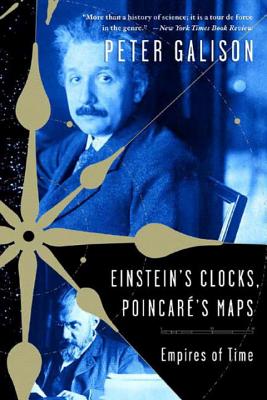
Peter Galison places the emergence of relativity amid the practical systems reshaping the late nineteenth century: railways, telegraph networks, and efforts to coordinate clocks across distance. The book traces parallel work by Albert Einstein, concerned with timekeeping in train stations and through telegraphy, and Henri Poincare, whose role at France’s Bureau of Longitude connected his mathematical work to mapping time across continents. Their different professional settings frame a shared question: whether simultaneity belongs to an absolute time or a relative one. Photographs, patents, and archival material support Galison’s account of how concrete problems of measurement intersected with a major theoretical shift in physics.

Good fit for readers who enjoy

  • Readers interested in the history of science and the development of relativity.
  • Those curious about Einstein and Poincare’s work in its technological and institutional context.
  • Readers interested in the historical links between timekeeping, transportation, and communication.

Themes

History of relativityTime measurement and simultaneityRailways and telegraphyScientific institutions and archives

Based on publisher information and book metadata.

Book overview

Clocks and trains, telegraphs and colonial conquest: the challenges of the late nineteenth century were an indispensable real-world background to the enormous theoretical breakthrough of relativity. And two giants at the foundations of modern science were converging, step-by-step, on the answer: Albert Einstein, an young, obscure German physicist experimenting with measuring time using telegraph networks and with the coordination of clocks at train stations; and the renowned mathematician Henri Poincare, president of the French Bureau of Longitude, mapping time coordinates across continents. Each found that to understand the newly global world, he had to determine whether there existed a pure time in which simultaneity was absolute or whether time was relative Esteemed historian of science Peter Galison has culled new information from rarely seen photographs, forgotten patents, and unexplored archives to tell the fascinating story of two scientists whose concrete, professional preoccupations engaged them in a silent race toward a theory that would conquer the empire of time.

Shipping & returnsShipping options, delivery timing, and our return policy.

In-stock items normally dispatch within 1–2 business days. The ZIP-code estimator on this page is informational only; the final shipping method, price, and availability are confirmed at checkout for your full order.

For the initial delivery estimate we use these transit windows after dispatch: Standard 5–8 business days, Expedited 2–4 business days, and Priority 1–2 business days. Holiday delays are not included.

Eligible items can be returned within 30 days in accordance with our return policy.

Customer reviews