Home › Computers › Document Object Model: Processing Structured Documents

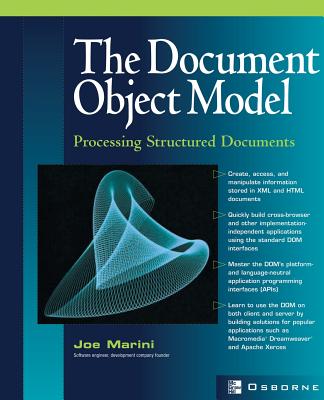
Document Object Model: Processing Structured Documents

by Joe Marini Publisher: OSBORNE

A foundational guide to the relationships inside HTML and XML documents

Regular price $44.11 USD
Regular price $73.52 USD Sale price $44.11 USD
Save 40%

Paperback New English

In stock · Dispatches in 1–2 business days
Delivery to your door
In stock·Dispatches in 1–2 business days
Standard shipping* from $4.35
Standard shipping transit* 5–8 business days after dispatch

Faster options are available.

Rates and delivery estimates depend on your destination and item quantity. Estimates are informational only; the final shipping method and rate are selected at checkout.

Secure checkout
American Express Apple Pay DiscoverGoogle Pay Mastercard PayPalVisa
30-day eligible returns Returns & refunds policy

AlbakiReads Editorial

A foundational guide to the relationships inside HTML and XML documents

Using the analogy of a house schematic, this technical guide frames the Document Object Model as a way to understand how the elements of structured documents are arranged, connected, and governed. Its subject is the DOM’s role in defining interactions among document objects—whether tables, information, or scripts—and why those relationships matter in system development. Published in 2002, the book is centered on the conceptual foundations of DOM-based work with HTML and XML rather than on current web-platform standards.

Good fit for readers who enjoy

  • Web developers building a conceptual understanding of the DOM
  • Programmers working with structured HTML or XML documents
  • Readers interested in how document elements and scripts relate within a system

Themes

Document Object ModelHTML and XML structureObject relationshipsWeb development foundationsDocument scripting

Based on publisher information and book metadata.

Book overview

Document Object Model Analogy: In many ways, the Document Object Model (DOM) can be compared to the schematic of a house. A house's schematic details the relation and placement of objects within a house. For instance, within a schematic, you are able to understand the relationship of the sink to the wall, as well as the corresponding plumbing. In other words, the schematic defines the relationship of one object to another and often, illustrates the rules by which they are governed. HTML and XML documents are also composed of objects, and although these objects may not be physical, like a sink, their organisation and interaction is still coordinated by a set of rules. In this case, the DOM acts as a foundation for the placement and interaction of objects within a document. Whether the object is a table, a piece of information, or a script, the DOM specifies a model for the interaction of these objects. For developers, a thorough understanding of these relationships is paramount, and often, it forms the basis for a system's development.
Shipping & returnsShipping options, delivery timing, and our return policy.

In-stock items normally dispatch within 1–2 business days. The ZIP-code estimator on this page is informational only; the final shipping method, price, and availability are confirmed at checkout for your full order.

For the initial delivery estimate we use these transit windows after dispatch: Standard 5–8 business days, Expedited 2–4 business days, and Priority 1–2 business days. Holiday delays are not included.

Eligible items can be returned within 30 days in accordance with our return policy.

Customer reviews

M
AlbakiReads
Malaika Taylor

I highly recommend to for anyone looking for inner clarity

T
AlbakiReads
Thomas DiMassa

Great service and fast service

Great shopping experience! The book arrived quickly, was well packaged, and matched the description perfectly. I would definitely shop with you again

O
AlbakiReads
Olivia

Smooth.