Home › Hardcover Books › Disposable Workers: The Transformation of Employment

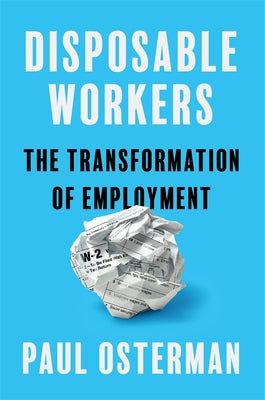
Disposable Workers: The Transformation of Employment

by Paul Osterman

Employment beyond the standard job

Regular price $29.53 USD
Regular price $39.38 USD Sale price $29.53 USD
Save 25%

Hardcover New

Delivery to your door
In stock·Dispatches in 1–2 business days
Standard shipping* from $4.35
Standard shipping transit* 5–8 business days after dispatch

Faster options are available.

Rates and delivery estimates depend on your destination and item quantity. Estimates are informational only; the final shipping method and rate are selected at checkout.

Secure checkout
American Express Apple Pay DiscoverGoogle Pay Mastercard PayPalVisa
30-day eligible returns Returns & refunds policy

AlbakiReads Editorial

Employment beyond the standard job

Paul Osterman examines a shift away from conventional employment toward contracting, freelancing, temporary work, and marginal jobs. Drawing on a survey of more than 6,000 workers, the book maps these arrangements across occupations, from service work to professional roles. It distinguishes marginal employees—legally employees, yet often kept outside job security, training, and promotion opportunities—from contractors and freelancers. The discussion connects these categories to workers’ access to benefits and career pathways, then turns to policy proposals aimed at limiting reliance on contingent arrangements and improving job quality for part-time and marginal employees.

Good fit for readers who enjoy

  • Readers interested in labor markets and changes in employment relationships.
  • Readers seeking research-based discussion of contractors, freelancers, and marginal employees.
  • Readers interested in policy proposals concerning job quality and employment protections.

Themes

Changing employment relationshipsContract and freelance workJob security and benefitsWorkplace policy

Based on publisher information and book metadata.

Book overview

A revealing look at the decline in formal employment in favor of hiring contractors, freelancers, temps, and marginal workers, who are excluded from traditional benefits and career ladders.

Companies cannot exist without workers, but they are increasingly reluctant to have employees. Instead of providing the benefits and protections that have traditionally come with employee status, businesses are turning to tactics that let them treat people as interchangeable parts, to be used and discarded as needed. Drawing on an original survey of over 6,000 workers, Disposable Workers reveals the striking extent of this transformation across the occupational hierarchy, affecting everyone from janitors to nurses.

Paul Osterman identifies three distinct categories of disposable workers: contractors, freelancers, and marginal employees. The marginal category, unique to Osterman's analysis, describes workers who are employees from a narrow legal standpoint but are held at arm's length by their firm--left without job security, skill training, or opportunities for promotion. Many low-wage service workers toil in marginal jobs, but so do white-collar professionals such as adjunct university faculty and staff attorneys at law firms. When the three categories are added up, they account for more than 35 percent of the American workforce.

Not all disposable workers object to their arrangements. But most contractors and marginal employees would prefer standard employment, and there is a significant cost to their current status. In response, Disposable Workers offers a range of policy recommendations, including mechanisms to prevent over-reliance on contracting and freelancing as well as reforms to improve job quality for part-timers and marginal employees. As the deconstruction of employment affects more and more workers, the importance of such measures will only grow.

Shipping & returnsShipping options, delivery timing, and our return policy.

In-stock items normally dispatch within 1–2 business days. The ZIP-code estimator on this page is informational only; the final shipping method, price, and availability are confirmed at checkout for your full order.

For the initial delivery estimate we use these transit windows after dispatch: Standard 5–8 business days, Expedited 2–4 business days, and Priority 1–2 business days. Holiday delays are not included.

Eligible items can be returned within 30 days in accordance with our return policy.

Customer reviews