Home › Mechanics › Crack initiation in composites at micro and meso scales: Development and applications of finite fracture mechanics

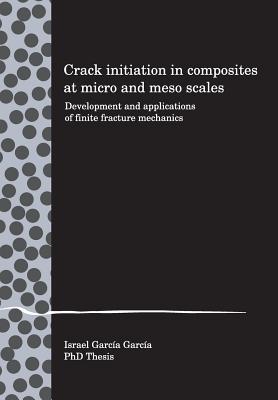
Crack initiation in composites at micro and meso scales: Development and applications of finite fracture mechanics

by Israel G. Garcia

Crack initiation across composite materials

Regular price $14.62 USD
Regular price $19.50 USD Sale price $14.62 USD
Save 25%

Paperback New

Delivery to your door
In stock·Dispatches in 1–2 business days
Standard shipping* from $4.35
Standard shipping transit* 5–8 business days after dispatch

Faster options are available.

Rates and delivery estimates depend on your destination and item quantity. Estimates are informational only; the final shipping method and rate are selected at checkout.

Secure checkout
American Express Apple Pay DiscoverGoogle Pay Mastercard PayPalVisa
30-day eligible returns Returns & refunds policy

AlbakiReads Editorial

Crack initiation across composite materials

Israel G. Garcia’s thesis examines how finite fracture mechanics can be used to predict the onset of failure in composites. It first discusses crack initiation and the coupled criterion, including its formulation and practical application. The second part applies that criterion to several mechanisms at different scales: fiber–matrix debonding under transverse loading, debonding around spherical inclusions, transverse cracking in cross-ply laminates, and crack initiation at a weak surface in a bonded V-notch. The work connects a general failure-prediction framework with specific cases in composite materials, from microscopic interfaces to larger laminate structures.

Good fit for readers who enjoy

  • Researchers and graduate-level students studying composite materials or solid mechanics
  • Readers interested in fracture mechanics and crack-initiation prediction
  • Engineers examining failure mechanisms in fiber- or particle-reinforced composites

Themes

Finite fracture mechanicsCrack initiationComposite failure mechanismsMultiscale material behavior

Based on publisher information and book metadata.

Book overview

This thesis deals with the application of the coupled criterion to characterize the first steps of failure mechanisms in composites. The coupled criterion was developed in the context of the finite fracture mechanics and is based on assuming that a crack of a finite extension appears abruptly when a stress criterion is fulfilled and this crack onset is energetically admissible. Using this criterion, the critical load leading to a crack onset can be expressed as a function of well-known physical properties of the material as strength and fracture toughness. The thesis outline can be divided into two main parts: The first part studies the phenomenon of crack initiation and the failure criterion employed here for its prediction. The controversial concept of crack initiation and the main tool employed to predict it are discussed. The formulation and the practical application of the coupled criterion are also reviewed. The second part describes the application of the coupled criterion to different failure mechanisms at different scales: fiber-matrix debonding under transverse loading in FRC, debonding of spherical inclusions in particle-reinforced composites, transverse cracking in cross-ply laminates and crack initiation at a weak surface in a bonded V-notch.
Shipping & returnsShipping options, delivery timing, and our return policy.

In-stock items normally dispatch within 1–2 business days. The ZIP-code estimator on this page is informational only; the final shipping method, price, and availability are confirmed at checkout for your full order.

For the initial delivery estimate we use these transit windows after dispatch: Standard 5–8 business days, Expedited 2–4 business days, and Priority 1–2 business days. Holiday delays are not included.

Eligible items can be returned within 30 days in accordance with our return policy.

Customer reviews