Home › Campaigns & Elections › Bankrupting Democracy: Campaign Spending in a Marketplace of Ideas

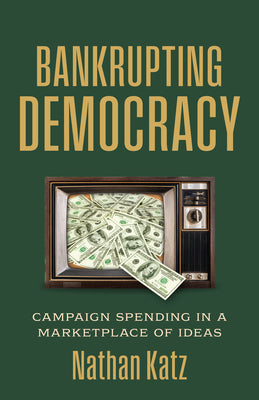
Bankrupting Democracy: Campaign Spending in a Marketplace of Ideas

by Nathan Katz Publisher: UNIV PR OF KANSAS

Campaign spending and the marketplace of ideas

Regular price $37.29 USD
Regular price $37.29 USD Sale price $37.29 USD

Paperback New English

In stock · Dispatches in 1–2 business days
Delivery to your door
In stock·Dispatches in 1–2 business days
Standard shipping* from $4.35
Standard shipping transit* 5–8 business days after dispatch

Faster options are available.

Rates and delivery estimates depend on your destination and item quantity. Estimates are informational only; the final shipping method and rate are selected at checkout.

Secure checkout
American Express Apple Pay DiscoverGoogle Pay Mastercard PayPalVisa
30-day eligible returns Returns & refunds policy

AlbakiReads Editorial

Campaign spending and the marketplace of ideas

Nathan Katz examines how the idea that campaign spending constitutes political speech has developed through legislative debates and Supreme Court decisions. The book traces what Katz calls the “money-speech paradigm,” treating the marketplace of ideas not as one abstract principle but as a system of norms and rules. Historical analysis is paired with attention to political advertising by candidates, parties, PACs, Super PACs, and interest groups, much of it on television. Together, these strands consider how campaign-finance arguments and spending patterns have shifted the system’s emphasis from candidates’ public exposure toward interest groups’ pursuit of influence, and what that shift means for American democratic institutions.

Good fit for readers who enjoy

  • Readers interested in campaign finance, elections, and political advertising.
  • Readers studying the relationship between the First Amendment and campaign spending.
  • Readers seeking a historical account of legislative and Supreme Court debates over campaign finance.

Themes

Campaign finance and political speechThe marketplace-of-ideas frameworkInterest groups and political advertisingDemocratic institutions and corporate power

Based on publisher information and book metadata.

Book overview

A deeply researched investigation that shows how the long-held ideas protecting unlimited campaign spending as free speech that once served the needs of political candidates and voters are now shaped to serve the desires of interest groups, threatening the future of American democracy.

In the 2010 Citizens United decision, Supreme Court Justice Anthony Kennedy stated that the precedent they were overturning "interferes with the 'open marketplace' of ideas protected by the First Amendment." For the majority who ruled in this case, money was in some sense the equivalent of speech, meaning that spending should be allowed under the guise of a marketplace of ideas. But what does this actually mean? And what are the consequences?

Both critics and advocates of this marketplace of ideas often treat it as an abstract principle; one that focuses on competition among different voices that allows for the most popular, and therefore best, ideas to gain prominence. But the marketplace of ideas is not a single tool. There are multiple mechanisms at play, all of which influence the rules and regulations behind this competition. Therefore, the marketplace of ideas should be understood not as a single idea but as a collection of smaller norms that build a regulatory, market-like system.

Bankrupting Democracy traces the development of this system, which Nathan Katz calls the "money-speech paradigm." Through a historical analysis of campaign finance reform discourses that have occurred within the legislative record and the Supreme Court, Katz demonstrates how these ideologies have caused radical changes to political speech. He pairs these data with an analysis of the changing patterns of political advertisers--the PACs, Super PACs, interest groups, candidates, and parties that all spend a large portion, often the majority, of their money on television advertisements. By combining these components, Katz shows how changes to the money-speech paradigm have shifted from a focus on political candidates and their right to public exposure to a system that focuses on supporting interest groups' pursuit of social and economic dominance.

At each stage in the development of the current system, proponents of the reforms assumed the security of democratic institutions, leaving them unprotected against the consolidation of corporate power. Bankrupting Democracy illuminates this market system that threatens to unravel the very fabric of American society.

Shipping & returnsShipping options, delivery timing, and our return policy.

In-stock items normally dispatch within 1–2 business days. The ZIP-code estimator on this page is informational only; the final shipping method, price, and availability are confirmed at checkout for your full order.

For the initial delivery estimate we use these transit windows after dispatch: Standard 5–8 business days, Expedited 2–4 business days, and Priority 1–2 business days. Holiday delays are not included.

Eligible items can be returned within 30 days in accordance with our return policy.

Customer reviews

M
AlbakiReads
Malaika Taylor

I highly recommend to for anyone looking for inner clarity

T
AlbakiReads
Thomas DiMassa

Great service and fast service

Great shopping experience! The book arrived quickly, was well packaged, and matched the description perfectly. I would definitely shop with you again

O
AlbakiReads
Olivia

Smooth.