


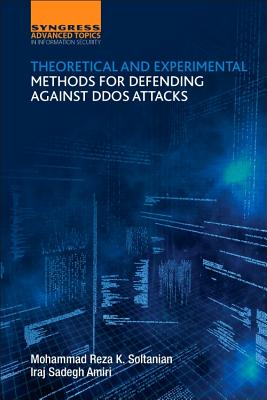
Theoretical and Experimental Methods for Defending Against DDoS Attacks
Regular price
$81.97 USD
Regular price
$81.97 USD
Sale price
$81.97 USD
Unit price
per
In stock — Ships within 1–2 business days
Format
Print Book
Currently viewing
Paperback
$81.97 USD
Secure CheckoutYour data is protected
Fast U.S. ShippingShips within 1–2 business days
Authentic Titles100% Genuine Books
AlbakiReads Editorial A short technical study of DDoS detection and prevention
A short technical study of DDoS detection and prevention
This compact computer-security title examines denial-of-service and distributed denial-of-service attacks as threats that overwhelm network resources. It outlines flood and amplification attack categories, including ICMP- and UDP-based flooding as well as Smurf and Fraggle attacks. The book then presents the authors’ research and a proposed prevention algorithm grounded in cryptographic concepts, using attack-rate estimation across routers to identify and block malicious traffic before it reaches a server. With its emphasis on attack mechanisms and an algorithmic defense model, it functions as a focused introduction to one approach to DDoS mitigation rather than a broad survey of cybersecurity.
Good fit for readers who enjoy
- Computer-security students studying denial-of-service attacks
- Network and security practitioners interested in DDoS detection approaches
- Readers seeking a brief, technical treatment of router-based traffic defense
Themes
DDoS attacksNetwork securityFlood and amplification attacksTraffic analysisCryptographic defense methods
Based on publisher information and book metadata.
Book Overview Denial of Service (DoS) attacks are a form of attack that seeks to make a network resource unavailable due to overloading the resource or...
Denial of Service (DoS) attacks are a form of attack that seeks to make a network resource unavailable due to overloading the resource or machine with an overwhelming number of packets, thereby crashing or severely slowing the performance of the resource. Distributed Denial of Service (DDoS) is a large scale DoS attack which is distributed in the Internet. Every computer which has access to the Internet can behave as an attacker. Typically bandwidth depletion can be categorized as either a flood or an amplification attack. Flood attacks can be done by generating ICMP packets or UDP packets in which it can utilize stationary or random variable ports. Smurf and Fraggle attacks are used for amplification attacks. DDoS Smurf attacks are an example of an amplification attack where the attacker sends packets to a network amplifier with the return address spoofed to the victim's IP address. This book presents new research and methodologies along with a proposed algorithm for prevention of DoS attacks that has been written based on cryptographic concepts such as birthday attacks to estimate the rate of attacks generated and passed along the routers. Consequently, attackers would be identified and prohibited from sending spam traffic to the server which can cause DDoS attacks. Due to the prevalence of DoS attacks, there has been a lot of research conducted on how to detect them and prevent them. The authors of this short format title provide their research results on providing an effective solution to DoS attacks, including introduction of the new algorithm that can be implemented in order to deny DoS attacks.
Book Details Format: Paperback | Pages: 74 | Language: English | Publisher: SYNGRESS MEDIA | ISBN: 0128053917
FormatPaperback
Pages74
LanguageEnglish
ISBN0128053917
EAN9780128053911
PublisherSYNGRESS MEDIA
Publication Date2015-11-16
Edition1
AccessoriesNo Accessory
ConditionNew
Product TypeQUALITY PAPERBACK BOOKS
Weight0.4 Pounds
Length8.8 Inches
Width5.9 Inches
Height0.4 Inches
Shipping & Returns Fast, reliable shipping and easy returns on eligible items.
Most orders ship within 1–2 business days with fast, reliable U.S. delivery.
Eligible items can be returned within 30 days in line with our store return policy.
Why shop with AlbakiReads
Fresh Inventory from Major Publishers
Sourced through trusted book distributors, with fresh titles added regularly.
Secure Checkout
Your payment information is encrypted and protected every step of the way.
Fast U.S. Shipping
Most orders ship within 1–2 business days.
Books for Every Kind of Reader
From page-turners to timeless classics—find your next favorite read.


