Home › Native American Studies › Sovereignty on Trial: The Cherokee Nation and the Fight for Native Rights

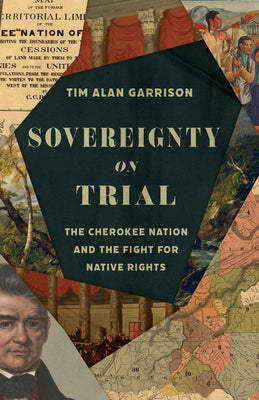
Sovereignty on Trial: The Cherokee Nation and the Fight for Native Rights

by Tim Alan Garrison

Three Supreme Court cases and the contested meaning of Cherokee sovereignty

Regular price $39.34 USD
Regular price $39.34 USD Sale price $39.34 USD

Paperback New English

Delivery to your door
In stock·Dispatches in 1–2 business days
Standard shipping* from $4.35
Standard shipping transit* 5–8 business days after dispatch

Faster options are available.

Rates and delivery estimates depend on your destination and item quantity. Estimates are informational only; the final shipping method and rate are selected at checkout.

Secure checkout
American Express Apple Pay DiscoverGoogle Pay Mastercard PayPalVisa
30-day eligible returns Returns & refunds policy

AlbakiReads Editorial

Three Supreme Court cases and the contested meaning of Cherokee sovereignty

Tim Alan Garrison places the Cherokee Nation’s legal struggle with Georgia within the history of three Supreme Court decisions known as the Marshall Trilogy. The book examines how the rulings offered conflicting accounts of Native nations’ rights and status, and how Georgia’s efforts to extend its authority over Cherokee territory unfolded alongside the Indian Removal Act. It also considers divisions within Cherokee national unity and the political strategies that shaped resistance through the courts. The account connects those early nineteenth-century conflicts to the Trail of Tears and to continuing debates in American Indian law and Native sovereignty.

Good fit for readers who enjoy

  • Readers studying Native American history, sovereignty, or American Indian law
  • Readers interested in the Supreme Court and the legal history of the early United States
  • Readers seeking historical context for the Cherokee Nation’s resistance to Georgia and Indian removal

Themes

Native sovereignty and political rightsSupreme Court history and American Indian lawCherokee resistance and national unityIndian removal and the Trail of Tears

Based on publisher information and book metadata.

Book overview

The story of the legal battle between the Cherokee Nation and the State of Georgia that ultimately led to the infamous Trail of Tears and the ongoing struggles for Native sovereignty.

Sovereignty on Trial tells the story of a trio of landmark United States Supreme Court cases--Johnson v. M'Intosh (1823), Cherokee Nation v. Georgia (1831), and Worcester v. Georgia (1832)--that considered the legal status of Native nations in the early nineteenth century.

Known as the Marshall Trilogy--majority opinions all written by Chief Justice John Marshall--the decisions are inconsistent in their holdings and reasoning, leaving American Indian law and interpretations of Native sovereignty confusing and ambiguous. In M'Intosh, Marshall used the imperial doctrine of discovery to diminish the property rights and autonomy of the Native nations. Subsequent interpretations of Marshall's opinion in Cherokee Nation, with its "guardian and ward" analogy, ultimately placed Native people in a dependent status with the United States. At the end of his judicial career, however, Marshall came to view Native rights in a different light, and his opinion in Worcester was a powerful acclamation of Native political sovereignty and territorial rights. Courts have tried with little success to find a coherent line through the three rulings.

The two Georgia cases resulted from the state's efforts to extend its jurisdiction over the Cherokee Nation and annihilate its government. These cases were decided against the backdrop of the Indian Removal Act of 1830. When President Andrew Jackson and Congress failed to enforce Worcester, Georgia interned and forcibly removed the Cherokee in the now infamous tragedy known as the Trail of Tears.

Tim Alan Garrison places this trio of cases in their broader legal and historical context. Significantly, Garrison explains why Georgia sought to expel the Cherokees from their homeland, how these attacks on native sovereignty tore apart Cherokee national unity, and how the changes in Cherokee political culture determined their strategy in resisting the state's onslaught. The Cherokee resistance against Georgia was a remarkable example of national courage for the Indigenous peoples of the world, and their determination to fight oppression through the judicial system of the United States left a lasting impact on American Indian law. The Cherokee Cases tells an important, if disturbing, story whose reverberations are felt to the present day.

Shipping & returnsShipping options, delivery timing, and our return policy.

In-stock items normally dispatch within 1–2 business days. The ZIP-code estimator on this page is informational only; the final shipping method, price, and availability are confirmed at checkout for your full order.

For the initial delivery estimate we use these transit windows after dispatch: Standard 5–8 business days, Expedited 2–4 business days, and Priority 1–2 business days. Holiday delays are not included.

Eligible items can be returned within 30 days in accordance with our return policy.

Customer reviews