Home › Automotive › People's Car: A Global History of the Volkswagen Beetle

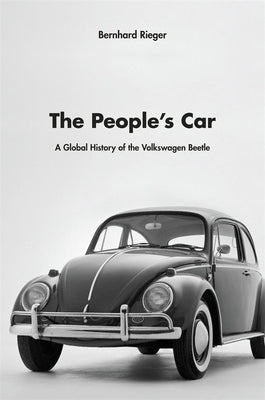
People's Car: A Global History of the Volkswagen Beetle

by Bernhard Rieger

How the Volkswagen Beetle Became a Global Symbol

Regular price $24.51 USD
Regular price $40.85 USD Sale price $24.51 USD
Save 40%

Hardcover New English

Delivery to your door
Currently unavailable
Secure checkout
American Express Apple Pay DiscoverGoogle Pay Mastercard PayPalVisa
30-day eligible returns Returns & refunds policy

AlbakiReads Editorial

How the Volkswagen Beetle Became a Global Symbol

Bernhard Rieger traces the Volkswagen Beetle from its 1938 debut under the Nazi regime to its changing meanings across postwar markets and cultures. The book places the car within industrial design, advertising, mass production, and consumer life, showing how one model could signify West Germany’s economic recovery, suburban life and countercultural identity in the United States, and durability amid instability in Mexico and Latin America. Drawing attention to the people involved in producing, promoting, collecting, and driving the Beetle, this history uses an automotive icon to examine the uneven processes of twentieth-century globalization.

Good fit for readers who enjoy

  • Readers interested in automotive and transportation history
  • Readers exploring consumer culture, advertising, and industrial design
  • Readers interested in twentieth-century German, American, and Latin American history

Themes

Volkswagen BeetleGlobalizationMass motorizationConsumer culture and advertisingPostwar economic history

Based on publisher information and book metadata.

Book overview

At the Berlin Auto Show in 1938, Adolf Hitler presented the prototype for a small, oddly shaped, inexpensive family car that all good Aryans could enjoy. Decades later, that automobile--the Volkswagen Beetle--was one of the most beloved in the world. Bernhard Rieger examines culture and technology, politics and economics, and industrial design and advertising genius to reveal how a car commissioned by Hitler and designed by Ferdinand Porsche became an exceptional global commodity on a par with Coca-Cola.

Beyond its quality and low cost, the Beetle's success hinged on its uncanny ability to capture the imaginations of people across nations and cultures. In West Germany, it came to stand for the postwar "economic miracle" and helped propel Europe into the age of mass motorization. In the United States, it was embraced in the suburbs, and then prized by the hippie counterculture as an antidote to suburban conformity. As its popularity waned in the First World, the Beetle crawled across Mexico and Latin America, where it symbolized a sturdy toughness necessary to thrive amid economic instability.

Drawing from a wealth of sources in multiple languages, The People's Car presents an international cast of characters--executives and engineers, journalists and advertisers, assembly line workers and car collectors, and everyday drivers--who made the Beetle into a global icon. The Beetle's improbable story as a failed prestige project of the Third Reich which became a world-renowned brand illuminates the multiple origins, creative adaptations, and persisting inequalities that characterized twentieth-century globalization.

Shipping & returnsShipping options, delivery timing, and our return policy.

In-stock items normally dispatch within 1–2 business days. The ZIP-code estimator on this page is informational only; the final shipping method, price, and availability are confirmed at checkout for your full order.

For the initial delivery estimate we use these transit windows after dispatch: Standard 5–8 business days, Expedited 2–4 business days, and Priority 1–2 business days. Holiday delays are not included.

Eligible items can be returned within 30 days in accordance with our return policy.

Customer reviews