Home › Social Science › The Negro Bible - The Slave Bible: Select Parts of the Holy Bible, Selected for the use of the Negro Slaves, in the British West-India Islands

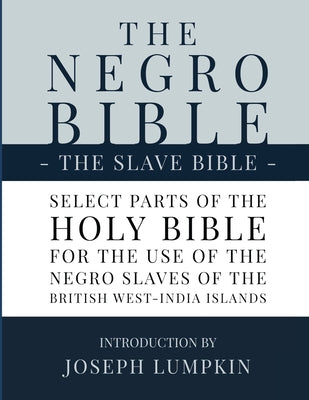
The Negro Bible - The Slave Bible: Select Parts of the Holy Bible, Selected for the use of the Negro Slaves, in the British West-India Islands

by Joseph B. Lumpkin

A Bible shaped by the politics of slavery

Regular price $35.02 USD
Regular price $54.72 USD Sale price $35.02 USD
Save 36%

Paperback New

Delivery to your door
In stock·Dispatches in 1–2 business days
Standard shipping* from $4.35
Standard shipping transit* 5–8 business days after dispatch

Faster options are available.

Rates and delivery estimates depend on your destination and item quantity. Estimates are informational only; the final shipping method and rate are selected at checkout.

Secure checkout
American Express Apple Pay DiscoverGoogle Pay Mastercard PayPalVisa
30-day eligible returns Returns & refunds policy

AlbakiReads Editorial

A Bible shaped by the politics of slavery

This volume brings together an introduction, a historical account, and a facsimile of the Slave Bible prepared for enslaved people in the British West Indies. Its subject is both the selected biblical text and the process of selection: the source describes missionaries compiling an edition that excluded material they feared could encourage resistance. The book frames those omissions as an example of religious narrative being controlled within the system of slavery, placing the artifact in the context of abolitionism, colonial labor, and the struggle for freedom. It offers a way to examine how a sacred text was adapted under coercive conditions.

Good fit for readers who enjoy

  • Readers researching the history of slavery and abolitionism.
  • Those interested in religious texts, colonial history, and the uses of scripture in systems of power.

Themes

Slavery and abolitionismCensorship and control of religious textsFreedom and resistanceColonial labor

Based on publisher information and book metadata.

Book overview

This is an Introduction, History, and Photocopy of the Slave Bible. - There was an uneasy tension as the slave owners sought to maintain control and keep the slaves working calmly and the abolitionists began to question the moral cost of slavery. The abolitionist movement was growing and for the first time, the souls of the slaves were being considered. As they prepared to compile a special Bible for slaves in the West Indies, the missionaries agreed to uplift the Africans without teaching them anything that could incite rebellion. Throughout history, the Bible has encouraged us to fight against our enslavement to sin, Hell, death, and the grave. But it has also encouraged us to fight against our fellow man who might choose to take our freedom and use us for his own purpose. Just as Egypt enslaved the Jews and used them for labor to build their empire, so were the slaves of Africa used to build the empire of the British West Indies and the United States. Just as Moses stood against the Egyptians and led the children of Israel out of slavery and bondage, so are we encouraged to stand up against the cruel bonds of slavery and fight for our freedom and the freedom of fellow man. The clarion call for human freedom is found in many forms and in various stories throughout the Bible, but all of these ideals were stripped from and carved out of the Slave Bible. The Slave Bible, also called The Negro Bible, is one of the most powerful examples ever witnessed of manipulation using a controlled narrative. The Christian faith, a religion one-third of the world relied on to bring comfort, spiritual rest, peace, and salvation was the narrative being controlled, making the Slave Bible the ultimate propaganda tool and the greatest lie ever told.

Shipping & returnsShipping options, delivery timing, and our return policy.

In-stock items normally dispatch within 1–2 business days. The ZIP-code estimator on this page is informational only; the final shipping method, price, and availability are confirmed at checkout for your full order.

For the initial delivery estimate we use these transit windows after dispatch: Standard 5–8 business days, Expedited 2–4 business days, and Priority 1–2 business days. Holiday delays are not included.

Eligible items can be returned within 30 days in accordance with our return policy.

Customer reviews