


Book overview
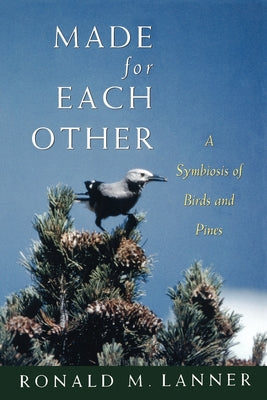
Some trees and birds are made for each other. Take, for example, the whitebark pine, a timberline tree that graces the moraines and ridgetops of the northern Rockies and the Sierra Nevada-Cascades system. This lovely five-needled pine, long-lived and rugged though it is, cannot reproduce without the help of Clark's nutcracker. And the nutcracker, though it captures insects in the summer and steals a bit of carrion, cannot raise its young in these alpine habitats without feeding them the nutritious seeds of the whitebark pine. Between them, these dwellers of the high mountains provide for each others' posterity, which leads biologists to label their relationship symbiotic, or mutualistic. But there is more to it than that, because in playing out their roles these partners change the landscape. The environment they create provides life's necessities to many other plants and animals. Working in concert, Clark's nutcracker and the whitebark pine build ecosystems.
In Made for Each Other: A Symbiosis of Birds and Pines, Ronald M. Lanner details for the first time this fascinating relationship between pine trees and Corvids (nutcrackers and jays), showing how mutualism can drive not only each others' evolution, but affect the ecology of many other members of the surrounding ecosystem as well. Lanner explains that many of the world's pines have seeds not adapted to wind dispersal. Fortunately, their seeds are harvested from the cone and scattered over many miles by seed-eating jays and nutcrackers who bury millions of seeds in the soil as a winter food source. Remarkably, these "pine nut" dependent birds can find their caches even through deep snow. Seeds left in the soil germinate, perpetuating the pines and guarantee future seeds for future birds. Moreover, the newly "planted" whitebark pine groves encourage further tree growth, such as Engelmann spruce, and eventually the patches of open-grown woodland coalesce, forming a continuous forest. Large forest stands offer cover for large animals like bear, elk, and moose, and provide territories for Red Squirrels. These squirrels also depend on pine seeds as a food source, storing large quantities of seeds on the ground, piled up against fallen logs or stumps, or buried in the forest litter. In the fall both black and grizzly bears are preparing to hibernate and must increase their stores of body fat. The seeds of whitebark pine are large and very rich, containing sixty to seventy percent fat, and are an ideal food for this purpose. The large seed reserves created by the squirrels become a feasting ground for these bears. Meanwhile, the sun-loving trees shaded out by the maturing decay offer housing for cavity-nesters like woodpeckers and nuthatches, as well as a breeding ground for fungi which are eagerly devoured by mule deer and red squirrels in search of protein. Eventually, when the forest is ignited in one of the thunderstorms so common and so violent in the high country, an open area is created, attracting nutcrackers in need of a new cache site, and the cycle begins again.
Focusing on the Rocky Mountains and the American Southwest, and ranging as far afield as the Alps, Finland, Siberia, and China, this beautifully illustrated and gracefully written work illuminates the phenomenon of co-evolution.
In Made for Each Other: A Symbiosis of Birds and Pines, Ronald M. Lanner details for the first time this fascinating relationship between pine trees and Corvids (nutcrackers and jays), showing how mutualism can drive not only each others' evolution, but affect the ecology of many other members of the surrounding ecosystem as well. Lanner explains that many of the world's pines have seeds not adapted to wind dispersal. Fortunately, their seeds are harvested from the cone and scattered over many miles by seed-eating jays and nutcrackers who bury millions of seeds in the soil as a winter food source. Remarkably, these "pine nut" dependent birds can find their caches even through deep snow. Seeds left in the soil germinate, perpetuating the pines and guarantee future seeds for future birds. Moreover, the newly "planted" whitebark pine groves encourage further tree growth, such as Engelmann spruce, and eventually the patches of open-grown woodland coalesce, forming a continuous forest. Large forest stands offer cover for large animals like bear, elk, and moose, and provide territories for Red Squirrels. These squirrels also depend on pine seeds as a food source, storing large quantities of seeds on the ground, piled up against fallen logs or stumps, or buried in the forest litter. In the fall both black and grizzly bears are preparing to hibernate and must increase their stores of body fat. The seeds of whitebark pine are large and very rich, containing sixty to seventy percent fat, and are an ideal food for this purpose. The large seed reserves created by the squirrels become a feasting ground for these bears. Meanwhile, the sun-loving trees shaded out by the maturing decay offer housing for cavity-nesters like woodpeckers and nuthatches, as well as a breeding ground for fungi which are eagerly devoured by mule deer and red squirrels in search of protein. Eventually, when the forest is ignited in one of the thunderstorms so common and so violent in the high country, an open area is created, attracting nutcrackers in need of a new cache site, and the cycle begins again.
Focusing on the Rocky Mountains and the American Southwest, and ranging as far afield as the Alps, Finland, Siberia, and China, this beautifully illustrated and gracefully written work illuminates the phenomenon of co-evolution.


