


Book overview
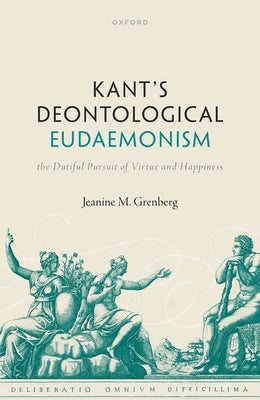
In this book, Professor Jeanine Grenberg defends the idea that Kant's virtue theory is best understood as a system of eudaemonism, indeed, as a distinctive form of eudaemonism that makes it preferable to other forms of it: a system of what she calls Deontological Eudaemonism. In Deontological Eudaemonism, one achieves happiness both rationally conceived (as non-felt pleasure in the virtually unimpeded harmonious activity of one's will and choice) and empirically conceived (as pleasurable fulfilment of one's desires) only via authentic commitment to and fulfilment of what is demanded of all rational beings: making persons as such one's end in all things.
To tell this story of Deontological Eudaemonism, Grenberg first defends the notion that Kant's deontological approach to ethics is simultaneously (and indeed, foundationally, and most basically) teleological. She then shows that the realization of an aptitude for the virtuous fulfilment of one's obligatory ends provides the solid basis for simultaneous realization of happiness, both rationally and empirically conceived. Along the way, she argues both that Kant's notion of happiness rationally conceived is essentially identical to Aristotle's conception of happiness as unimpeded activity, and that his notion of happiness empirically conceived is best realized via an unwavering commitment to the fulfilment of one's obligatory ends.
To tell this story of Deontological Eudaemonism, Grenberg first defends the notion that Kant's deontological approach to ethics is simultaneously (and indeed, foundationally, and most basically) teleological. She then shows that the realization of an aptitude for the virtuous fulfilment of one's obligatory ends provides the solid basis for simultaneous realization of happiness, both rationally and empirically conceived. Along the way, she argues both that Kant's notion of happiness rationally conceived is essentially identical to Aristotle's conception of happiness as unimpeded activity, and that his notion of happiness empirically conceived is best realized via an unwavering commitment to the fulfilment of one's obligatory ends.


