Home › Automotive › Installing Automobility: Emerging Politics of Mobility and Streets in Indian Cities

Installing Automobility: Emerging Politics of Mobility and Streets in Indian Cities

by Govind Gopakumar

How Bengaluru’s streets came to favor the automobile

Regular price $53.17 USD
Regular price $53.17 USD Sale price $53.17 USD

Paperback New English

Delivery to your door
In stock·Dispatches in 1–2 business days
Standard shipping* from $4.35
Standard shipping transit* 5–8 business days after dispatch

Faster options are available.

Rates and delivery estimates depend on your destination and item quantity. Estimates are informational only; the final shipping method and rate are selected at checkout.

Secure checkout
American Express Apple Pay DiscoverGoogle Pay Mastercard PayPalVisa
30-day eligible returns Returns & refunds policy

AlbakiReads Editorial

How Bengaluru’s streets came to favor the automobile

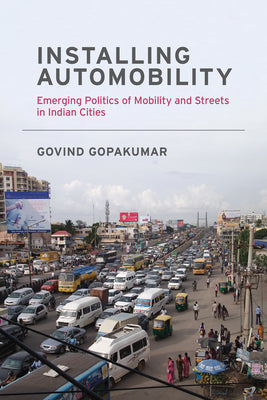
Govind Gopakumar examines automobility in Bengaluru as a political and spatial process, not simply a matter of traffic growth. The book traces how private motorized transport and its supporting infrastructure have become central to a rapidly expanding Indian metropolis, while pedestrians, cyclists, vendors, and other non-automobile users are pushed to the margins. Its framework links congestion, urban change, infrastructure, and unequal access to the idea of “automotive citizenship.” The analysis also situates these developments within Bengaluru’s history and considers pressures—from waste flows to religion and political leadership—that complicate, but do not overturn, automobile-centered urban development. It closes by presenting a case for reorganizing mobility and reclaiming streets for other public uses.

Good fit for readers who enjoy

  • Readers interested in urban transportation politics and street design
  • Students of Indian cities, Global South urbanism, and infrastructure
  • Those examining equity and access in mobility systems

Themes

AutomobilityUrban infrastructureMobility justiceBengaluruPublic streets

Based on publisher information and book metadata.

Book overview

An examination of the process of prioritizing private motorized transportation in Bengaluru, a rapidly growing megacity of the Global South.

Automobiles and their associated infrastructures, deeply embedded in Western cities, have become a rapidly growing presence in the mega-cities of the Global South. Streets once crowded with pedestrians, pushcarts, vendors, and bicyclists are now choked with motor vehicles, many of them private automobiles. In this book, Govind Gopakumar examines this shift, analyzing the phenomenon of automobility in Bengaluru (formerly known as Bangalore), a rapidly growing city of about ten million people in southern India. He finds that the advent of automobility in Bengaluru has privileged the mobility needs of the elite while marginalizing those of the rest of the population.

Gopakumar connects Bengaluru's burgeoning automobility to the city's history and to the spatial, technological, and social interventions of a variety of urban actors. Automobility becomes a juggernaut, threatening to reorder the city to enhance automotive travel. He discusses the evolution of congestion and urban change in Bengaluru; the "regimes of congestion" that emerge to address the issue; an "infrastructurescape" that shapes the mobile behavior of all residents but is largely governed by the privileged; and the enfranchisement of an "automotive citizenship" (and the disenfranchisement of non-automobile-using publics). Gopakumar also finds that automobility in Bengaluru faces ongoing challenges from such diverse sources as waste flows, popular religiosity, and political leadership. These challenges, however, introduce messiness without upsetting automobility. He therefore calls for efforts to displace automobility that are grounded in reordering the mobility regime, relandscaping the city and its infrastructures, and reclaiming streets for other uses.

Shipping & returnsShipping options, delivery timing, and our return policy.

In-stock items normally dispatch within 1–2 business days. The ZIP-code estimator on this page is informational only; the final shipping method, price, and availability are confirmed at checkout for your full order.

For the initial delivery estimate we use these transit windows after dispatch: Standard 5–8 business days, Expedited 2–4 business days, and Priority 1–2 business days. Holiday delays are not included.

Eligible items can be returned within 30 days in accordance with our return policy.

Customer reviews