Home › Eye › How Do Bees (and Humans) See Grey Levels?: Intuitive, logical, and anti-intuitive explanations for some curious observations

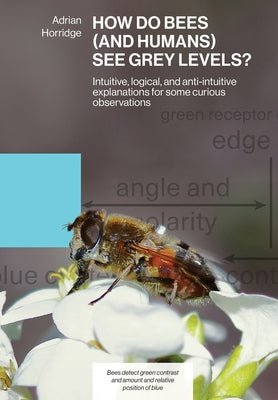
How Do Bees (and Humans) See Grey Levels?: Intuitive, logical, and anti-intuitive explanations for some curious observations

by Adrian Horridge

How bees and humans perceive grey

Regular price $20.36 USD
Regular price $25.45 USD Sale price $20.36 USD
Save 20%

Paperback New

Delivery to your door
In stock·Dispatches in 1–2 business days
Standard shipping* from $4.35
Standard shipping transit* 5–8 business days after dispatch

Faster options are available.

Rates and delivery estimates depend on your destination and item quantity. Estimates are informational only; the final shipping method and rate are selected at checkout.

Secure checkout
American Express Apple Pay DiscoverGoogle Pay Mastercard PayPalVisa
30-day eligible returns Returns & refunds policy

AlbakiReads Editorial

How bees and humans perceive grey

Adrian Horridge examines how visual systems interpret grey, black, white and colour, setting observations about bees alongside questions about human perception. The discussion revisits historical experiments, including von Frisch’s tests with coloured paper and shades of grey, and considers how ultraviolet sensitivity and brightness discrimination affect their interpretation. Horridge contrasts bees’ dichromatic vision with human vision, while also discussing claims about colour perception in other animals. The book places these questions in historical context and challenges familiar assumptions about what bees, pets and people can see. Its subject sits at the intersection of visual biology and the ways scientific observations can be misunderstood.

Good fit for readers who enjoy

  • Readers interested in bee vision and animal perception
  • Readers curious about how humans perceive colour, grey and black
  • Readers seeking a historical discussion of experiments in vision

Themes

Bee visionHuman colour perceptionDichromatic visionHistory of scientific observationInterpretation of visual experiments

Based on publisher information and book metadata.

Book overview

There are several sources of serious confusion in the investigations of how bees and humans see grey and black. First, von Frisch trained bees to go to a coloured paper, and then tested whether they could distinguish that colour from a palette of 15 shades of grey placed together on a test board. Unfortunately, he used papers made from wood pulp, which do not reflect ultraviolet, so the UV receptors were excluded. Secondly,16 years later it was shown that bees require a 25% difference in brightness to discriminate grey levels, so his test was uncertain. Thirdly, bees are dichromats, and detect only green contrast and the fraction of light that stimulates the blue receptors. The most interesting confusion is that grey photons do not exist, but that does not affect bees because they are functional dichromats and treat grey like any other colour. No problem. The UV receptors in the compound eyes of the bee are used to detect the direction of the sky to stabilize flight and escape upwards when disturbed.

The bee is a sexless herbivore, which may account for its relatively simple retina. Additional colour types of receptor have been found by recording from eyes of some flies, butterflies and dragonflies, presumably for unique recognition of the other sex or prey. However, this is one-purpose vision which does not require much processing or large brain. Full colour vision requires at least three colour types of receptors and a large visual cortex, as in primates.

Human vision is more difficult to understand in this context. Black is entirely a hallucination because there are no black photons. White is detected normally with three receptor types acting together, but the brightest objects in sight also look white even though they are green or red, maybe as a calibration. The edges of shiny objects also look white although clearly they are not. Grey is hallucinated as various levels of black where there is white but insufficient illumination to see it as white.

These topics are discussed in historical context. However, some who work on the vision of the bee still believe that bees have full colour vision, and many believe that their dog or cat sees only black and white, so called achromatic vision. However, like the bee, they all evolved in world where green predominated, and many things of interest were less blue (e.g., yellow) or more blue than green (e.g., blue), so most mammals evolved as dichromats, without UV or red receptors.
Shipping & returnsShipping options, delivery timing, and our return policy.

In-stock items normally dispatch within 1–2 business days. The ZIP-code estimator on this page is informational only; the final shipping method, price, and availability are confirmed at checkout for your full order.

For the initial delivery estimate we use these transit windows after dispatch: Standard 5–8 business days, Expedited 2–4 business days, and Priority 1–2 business days. Holiday delays are not included.

Eligible items can be returned within 30 days in accordance with our return policy.

Customer reviews