


House in the Sun: Modern Architecture and Solar Energy in the Cold War
Regular price
$100.81 USD
Regular price
$106.12 USD
Sale price
$100.81 USD
Unit price
per
You save $5.31 USD (5%)
In stock — Ships within 1–2 business days
Format
Print Book
Currently viewing
Hardcover
$100.81 USD
$106.12 USD
Secure CheckoutYour data is protected
Fast U.S. ShippingShips within 1–2 business days
Authentic Titles100% Genuine Books
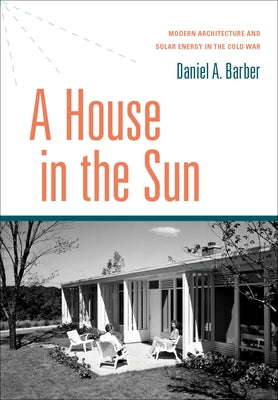
Book Overview A House in the Sun describes a number of experiments in solar house heating in American architectural, engineering, political, economic, ...
A House in the Sun describes a number of experiments in solar house heating in American architectural, engineering, political, economic, and corporate contexts from the beginning of World War II until the late 1950s. Houses were built across the Midwest, Northeast, and Southwestern United States, and also proposed for sites in India, South Africa, and Morocco. These experiments developed in parallel to transformations in the discussion of modern architecture, relying on new materials and design ideas for both energy efficiency and claims to cultural relevance. Architects were among the myriad cultural and scientific actors to see the solar house as an important designed element of the American future. These experiments also developed as part of a wider analysis of the globe as an interconnected geophysical system. Perceived resource limitations in the immediate postwar period led to new understandings of the relationship between energy, technology and economy. The solar house - both as a charged object in the milieu of suburban expansion, and as a means to raise the standard of living in developing economies - became an important site for social, technological, and design experimentation. This led to new forms of expertise in architecture and other professions.
Daniel Barber argues that this mid-century interest in solar energy was one of the first episodes in which resource limitations were seen as an opportunity for design to attain new relevance for potential social and cultural transformations. Furthermore, the solar discussion established both an intellectual framework and a funding structure for the articulation of and response to global environmental concerns in subsequent decades. In presenting evidence of resource tensions at the beginning of the Cold War, the book offers a new perspective on the histories of architecture, technology, and environmentalism, one more fully entangled with the often competing dynamics of geopolitical and geophysical pressures.
Book Details Format: Hardcover | Pages: 336 | Language: English | Publisher: OXFORD UNIV PR | ISBN: 0199394016
FormatHardcover
Pages336
LanguageEnglish
ISBN0199394016
EAN9780199394012
PublisherOXFORD UNIV PR
Publication Date1970-01-01
EditionIllustrated
AccessoriesNo Accessory
ConditionNew
Product TypeHARD COVER BOOKS
Weight2.15 Pounds
Length10.1 Inches
Width7.1 Inches
Height0.8 Inches
Shipping & Returns Fast, reliable shipping and easy returns on eligible items.
Most orders ship within 1–2 business days with fast, reliable U.S. delivery.
Eligible items can be returned within 30 days in line with our store return policy.
Why shop with AlbakiReads
Fresh Inventory from Major Publishers
Sourced through trusted book distributors, with fresh titles added regularly.
Secure Checkout
Your payment information is encrypted and protected every step of the way.
Fast U.S. Shipping
Most orders ship within 1–2 business days.
Books for Every Kind of Reader
From page-turners to timeless classics—find your next favorite read.


