


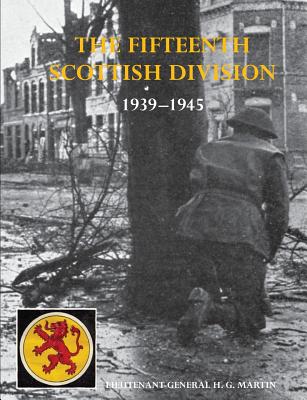

Book overview
The division was a second line Territorial Army Division, the duplicate of the British 52nd (Lowland) Division and served in the Second World War, where, among other actions, it was part of VIII Corps under Lieutenant-General Sir Richard O'Connor in Normandy and it ended the war on the Elbe River. WW2 Divisional service included: Operation Epsom was a British attack intended to outflank and seize Caen in France during the Battle of Normandy during the Second World War. It did not achieve its overall objective but forced the Germans to abandon their offensive plans and tied most of their armoured units to a defensive role. To be certain of anticipating any German attack Epsom was launched on 26 June. Although held up on parts of the front by infantry of the 12th SS Panzer Division Hitlerjugend, the 15th (Scottish) Infantry Division and the 31st Armoured Brigade gained four miles on their left flank. Further to their left the 43rd (Wessex) Infantry Division also gained ground. On 27 June, after repulsing small armoured counter-attacks, the 15th (Scottish) Division gained more ground and captured a bridge over the River Odon. The 11th Armoured Division passed through to capture Hill 112, a mile to the southeast. This deep penetration alarmed the German command and General Hausser was ordered to commit his units to contain and eliminate the Allied salient. German armoured counter-attacks from 27 June-1 July were repulsed and the foothold over the Odon was consolidated. German losses, particularly of armoured vehicles meant that the possibility of a German counter-offensive was eliminated and held the bulk of the remaining German armour in Normandy in the east around Caen, while US troops further west captured Cherbourg. Hill 112, Operation Jupiter The British forces included the men of the 15th Scottish Division, 11th Armoured Division, 43rd Wessex Division and 53rd Welsh Division. Principal among the units fighting on Hill 112, and the tanks of 7th and 9th Royal Tank Regiments, plus numerous other units. Approximately 63,000 men over a period of seven weeks fought on and around Hill 112. The first battle for Hill 112 was fought at the end of Operation Epsom, when the tanks of 11th Armoured Division broke out from a bridgehead established by the 2nd Argyll and Sutherland Highlanders at Tourmauville. Hill 112 was only an intermediate objective on the way to the River Orne crossings but such was the German reaction that the 23rd Hussars were only able to capture and hold the hill with difficulty. The main attack on Hill 112 was strategically designed to FIX the German panzers and tactically to gain 'elbow room' in what was still a tight beachhead. The German defenders survived naval bombardment, air attack and artillery fire but held their ground, crucially supported by Tiger tanks from the 101st SS Heavy Panzer Battalion. These mighty tanks armed with the 88 mm gun had both greater protection and firepower and outclassed the opposing British Churchill tank and Sherman tank. Even though the hill was not captured and was left as a no-man's-land between the two armies, important surrounding villages had been taken. Above all, however, the 9th Hohenstaufen SS Panzer Division, which had been in the process of moving out of the line to form an operational reserve, was brought back to contain the British. Therefore, on the strategic level Operation JUPITER was a significant success. It was not until American troops eventually started to break out from the Normandy lodgement, as Operation Cobra developed momentum, in August 1944, that the Germans withdrew from Hill 112 and the 53rd Welsh Division occupied the feature, with barely a fight. Casualties during that period amounted to approximately 25,000 British troops and 500 British tanks. Operations Bluecoat and Enterprise Operation Bluecoat was an attack by the British Second Army in the Battle of Normandy, from 30 July 1944 to 7 August 1944.


