Home › Cognitive Psychology & Cognition › Handbook of Learning and Cognitive Processes (Volume 6): Linguistic Functions in Cognitive Theory

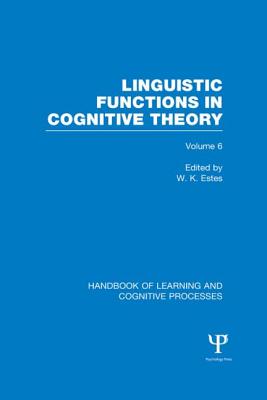
Handbook of Learning and Cognitive Processes (Volume 6): Linguistic Functions in Cognitive Theory

by William K. Estes

Language and cognition in a research-focused collection

Regular price $85.37 USD
Regular price $94.86 USD Sale price $85.37 USD
Save 10%

Paperback New English

Delivery to your door
In stock·Dispatches in 1–2 business days
Standard shipping* from $4.35
Standard shipping transit* 5–8 business days after dispatch

Faster options are available.

Rates and delivery estimates depend on your destination and item quantity. Estimates are informational only; the final shipping method and rate are selected at checkout.

Secure checkout
American Express Apple Pay DiscoverGoogle Pay Mastercard PayPalVisa
30-day eligible returns Returns & refunds policy

AlbakiReads Editorial

Language and cognition in a research-focused collection

This volume brings psycholinguistic research into the broader study of learning and cognitive theory. Its chapters trace connections across semantic memory, comprehension, memory coding, reading and the recognition of letters and words, before turning to speech perception and its links with perception and short-term memory. The collection closes with a chapter documenting how concepts and principles in the field developed. Originally published in 1978, it completes a six-volume survey planned around research and models for general cognitive theory. The emphasis is on how distinct lines of inquiry inform one another, making the book a structured record of a particular period in cognitive research.

Good fit for readers who enjoy

  • Readers studying cognitive psychology, cognition, or psycholinguistics.
  • Researchers interested in the history and development of cognitive theory.
  • Readers seeking collected work on memory, reading, and speech perception.

Themes

Psycholinguistics and cognitive theorySemantic memory and comprehensionReading and perceptual learningSpeech perceptionHistory of research concepts

Based on publisher information and book metadata.

Book overview

Originally published in 1978, Volume 6 concludes the survey of research and theory on learning and cognitive processes that was envisaged when the plan for this Handbook was sketched.

The primary orientation in the planning the Handbook was to concentrate on research and models aimed toward the development of general cognitive theory.

The first five chapters of this volume are organized in relation to one of the research areas that had expanded most vigorously during the period of planning and writing of the Handbook. These chapters treat aspects of psycholinguistics most closely related to research and theory covered in the other volumes. Perhaps the most fertile source of new concepts and models closely related to other branches of cognitive theory has been research on semantic memory. This work is given a critical review and interpretation by Smith in the first chapter of this volume, following which some lines of theoretical developmental leading "upward" into problems of comprehension of meaningful material are reviewed by Kintsch, then connections "downward" into more elementary problems of coding in memory by Johnson. Also, Johnson's chapter shades into the very active current body of work on perceptual and memorial processes in reading, carried further by Baron's examination of perceptual learning in relation to letter and word recognition. Finally, we consider inputs to the psycholinguistic system via speech and speech perception. The strong emphasis of Pisoni's chapter on speech perception rather than production simply reflects both the predominance of research on perceptual aspects of speech in the current cognitive literature and the close relationships of this research to other lines of investigation of perception and short-term memory.

Some knowledge of the history of the subject and some understanding of the way some of the more persuasive concepts and principles have evolved may serve present-day investigators better than boosting their reading rates. The final chapter of the present volume provides some documentation for this last suggestion.

Shipping & returnsShipping options, delivery timing, and our return policy.

In-stock items normally dispatch within 1–2 business days. The ZIP-code estimator on this page is informational only; the final shipping method, price, and availability are confirmed at checkout for your full order.

For the initial delivery estimate we use these transit windows after dispatch: Standard 5–8 business days, Expedited 2–4 business days, and Priority 1–2 business days. Holiday delays are not included.

Eligible items can be returned within 30 days in accordance with our return policy.

Customer reviews