Home › Game Theory › Game Theoretic Analysis

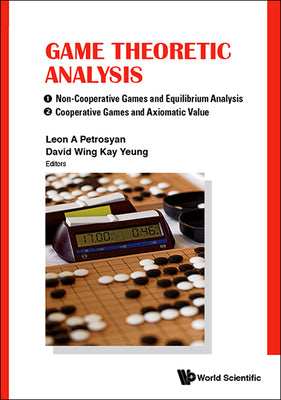
Game Theoretic Analysis

by Petrosyan Leon a

Research perspectives on games and strategic decisions

Regular price $235.05 USD
Regular price $261.17 USD Sale price $235.05 USD
Save 10%

Hardcover New English

Delivery to your door
In stock·Dispatches in 1–2 business days
Standard shipping* from $4.35
Standard shipping transit* 5–8 business days after dispatch

Faster options are available.

Rates and delivery estimates depend on your destination and item quantity. Estimates are informational only; the final shipping method and rate are selected at checkout.

Secure checkout
American Express Apple Pay DiscoverGoogle Pay Mastercard PayPalVisa
30-day eligible returns Returns & refunds policy

AlbakiReads Editorial

Research perspectives on games and strategic decisions

Organized in two parts, this 620-page collection examines non-cooperative games and equilibrium analysis alongside cooperative games and axiomatic values. Its coverage spans static and dynamic contexts, connecting the analysis of individual strategies and outcomes with approaches to group solutions. The structure makes the contrast between competition without externally enforced cooperation and frameworks for cooperative decision-making a central thread. As a collection of contributions in game theory, it offers a broad subject-based survey rather than a single continuous argument.

Good fit for readers who enjoy

  • Readers studying game theory, mathematics, or strategic decision-making.
  • Researchers and advanced students interested in equilibrium analysis or cooperative-game approaches.

Themes

Non-cooperative gamesEquilibrium analysisCooperative gamesAxiomatic valuesStrategic decision-making

Based on publisher information and book metadata.

Book overview

This is a collection of recent novel contributions in game theory from a group of prominent authors in the field. It covers Non-cooperative Games, Equilibrium Analysis, Cooperative Games and Axiomatic Values in static and dynamic contexts.

Part 1: Non-cooperative Games and Equilibrium Analysis

In game theory, a non-cooperative game is a game with competition between individual players and in which only self-enforcing (e.g. through credible threats) alliances (or competition between groups of players, called "coalitions") are possible due to the absence of external means to enforce cooperative behavior (e.g. contract law), as opposed to cooperative games. In fact, non-cooperative games are the foundation for the development of cooperative games by acting as the status quo. Non-cooperative games are generally analysed through the framework of equilibrium, which tries to predict players' individual strategies and payoffs. Indeed, equilibrium analysis is the centre of non-cooperative games. This volume on non-cooperative games and equilibrium analysis contains a variety of non-cooperative games and non-cooperative game equilibria from prominent authors in the field.

Part 2: Cooperative Games and Axiomatic Values

It is well known that non-cooperative behaviours, in general, would not lead to a Pareto optimal outcome. Highly undesirable outcomes (like the prisoner's dilemma) and even devastating results (like the tragedy of the commons) could appear when the involved parties only care about their individual interests in a non-cooperative situation. Cooperative games offer the possibility of obtaining socially optimal and group efficient solutions to decision problems involving strategic actions. In addition, axiomatic values serve as guidance for establishing cooperative solutions. This volume on cooperative games and axiomatic values presents a collection of cooperative games and axiomatic values from prominent authors in the field.

Shipping & returnsShipping options, delivery timing, and our return policy.

In-stock items normally dispatch within 1–2 business days. The ZIP-code estimator on this page is informational only; the final shipping method, price, and availability are confirmed at checkout for your full order.

For the initial delivery estimate we use these transit windows after dispatch: Standard 5–8 business days, Expedited 2–4 business days, and Priority 1–2 business days. Holiday delays are not included.

Eligible items can be returned within 30 days in accordance with our return policy.

Customer reviews