Home › Books for Ages 9–12 › The Eclipse of 1919: How Einstein's Theory of General Relativity Changed Our World

The Eclipse of 1919: How Einstein's Theory of General Relativity Changed Our World

by Emily Arnold McCully

A solar eclipse tests a new view of gravity

Regular price $17.08 USD
Regular price $28.47 USD Sale price $17.08 USD
Save 40%

Hardcover New English

Delivery to your door
In stock·Dispatches in 1–2 business days
Standard shipping* from $4.35
Standard shipping transit* 5–8 business days after dispatch

Faster options are available.

Rates and delivery estimates depend on your destination and item quantity. Estimates are informational only; the final shipping method and rate are selected at checkout.

Secure checkout
American Express Apple Pay DiscoverGoogle Pay Mastercard PayPalVisa
30-day eligible returns Returns & refunds policy

AlbakiReads Editorial

A solar eclipse tests a new view of gravity

Albert Einstein’s ideas about gravity, light, space, and time lead to a practical question: could the sun bend light from a nearby star? This 40-page children’s biography centers on the 1919 eclipse observations through which scientist Arthur Eddington tested Einstein’s theory of general relativity. The episode connects an abstract account of the universe with observation and photography, placing scientific inquiry alongside a striking natural event. The book also frames the story around the pursuit of knowledge and the relationship between nature and science.

Good fit for readers who enjoy

  • Children ages 9–12 interested in Albert Einstein and scientific biography
  • Young readers curious about astronomy, eclipses, and how scientific ideas are tested

Themes

General relativityScientific observationAstronomy and eclipsesNature and the pursuit of knowledge

Based on publisher information and book metadata.

Book overview

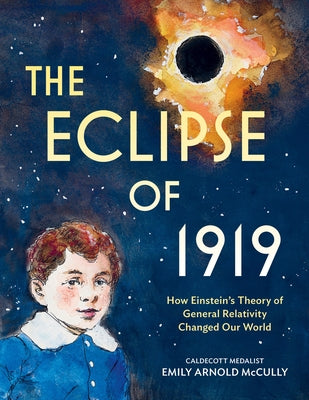
From his earliest days as a child, Albert Einstein was fascinated with the relationship between light and gravity. He couldn't stop thinking about the laws of the universe, and was determined to describe how motion and time, and energy and mass, all worked together. Einstein imagined gravity as what happens when objects bend the space and time around them. But this theory couldn't be perceived in the everyday world. To test his hypothesis, Einstein needed to see if the sun's gravity bent the light from a nearby star. And the only way to do that was to photograph a total solar eclipse. This is the story of how scientist Arthur Eddington validated Albert Einstein's theory of general relativity, permanently altering the world's understanding of the universe and beyond. It's a testament to the relationship between nature, science, and the pursuit of knowledge.
Shipping & returnsShipping options, delivery timing, and our return policy.

In-stock items normally dispatch within 1–2 business days. The ZIP-code estimator on this page is informational only; the final shipping method, price, and availability are confirmed at checkout for your full order.

For the initial delivery estimate we use these transit windows after dispatch: Standard 5–8 business days, Expedited 2–4 business days, and Priority 1–2 business days. Holiday delays are not included.

Eligible items can be returned within 30 days in accordance with our return policy.

Customer reviews