


Book overview
During the 1952 World Series, a Yankee fan trying to watch the game in a Brooklyn bar was told, "Why don't you go back where you belong, Yankee lover?" "I got a right to cheer my team," the intruder responded, "this is a free country." "This ain't no free country, chum," countered the Dodger fan, "this is Brooklyn." Brooklynites loved their "Bums"--Pee Wee Reese, Jackie Robinson, Duke Snider, Roy Campanella, and all the murderous parade of regulars who, after years of struggle, finally won the World Series in 1955. One could not live in Brooklyn and not catch its spirit of devotion to its baseball club.
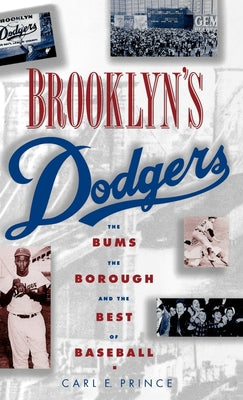
In Brooklyn's Dodgers, Carl E. Prince captures the intensity and depth of the team's relationship to the community and its people in the 1950s. Ethnic and racial tensions were part and parcel of a working class borough; the Dodgers' presence smoothed the rough edges of the ghetto conflict always present in the life of Brooklyn. The Dodger-inspired baseball program at the fabled Parade Grounds provided a path for boys that occasionally led to the prestigious "Dodger Rookie Team," and sometimes, via minor league contracts, to Ebbets Field itself. There were the boys who lined Bedford Avenue on game days hoping to retrieve home run balls and the men in the many bars who were not only devoted fans but collectively the keepers of the Dodger past--as were Brooklyn women, and in numbers. Indeed, women were tied to the Dodgers no less than their husbands, fathers, brothers, and sons; they were only less visible. A few, like Pulitzer Prize-winning poet Marianne Moore and working class stiff Hilda Chester were regulars at Ebbets Field and far from invisible. Prince also explores the underside of the Dodgers--the "baseball Annies," and the paternity suits that went with the territory. The Dodgers' male culture was played out as well in the team's politics, in the owners' manipulation of Dodger male egos, opponents' race-baiting, and the macho bravado of the team (how Jackie Robinson, for instance, would prod Giants' catcher Sal Yvars to impotent rage by signaling him when he was going to steal second base, then taunting him from second after the steal).
The day in 1957 when Walter O'Malley, the owner of the Brooklyn Dodgers, announced that the team would be leaving for Los Angeles was one of the worst moments in baseball history, and a sad day in Brooklyn's history as well. The Dodger team was, to a degree unmatched in other major league cities, deeply enmeshed in the life and psyche of Brooklyn and its people. In this superb volume, Carl Prince illuminates this "Brooklyn" in the golden years after the Second World War.
In Brooklyn's Dodgers, Carl E. Prince captures the intensity and depth of the team's relationship to the community and its people in the 1950s. Ethnic and racial tensions were part and parcel of a working class borough; the Dodgers' presence smoothed the rough edges of the ghetto conflict always present in the life of Brooklyn. The Dodger-inspired baseball program at the fabled Parade Grounds provided a path for boys that occasionally led to the prestigious "Dodger Rookie Team," and sometimes, via minor league contracts, to Ebbets Field itself. There were the boys who lined Bedford Avenue on game days hoping to retrieve home run balls and the men in the many bars who were not only devoted fans but collectively the keepers of the Dodger past--as were Brooklyn women, and in numbers. Indeed, women were tied to the Dodgers no less than their husbands, fathers, brothers, and sons; they were only less visible. A few, like Pulitzer Prize-winning poet Marianne Moore and working class stiff Hilda Chester were regulars at Ebbets Field and far from invisible. Prince also explores the underside of the Dodgers--the "baseball Annies," and the paternity suits that went with the territory. The Dodgers' male culture was played out as well in the team's politics, in the owners' manipulation of Dodger male egos, opponents' race-baiting, and the macho bravado of the team (how Jackie Robinson, for instance, would prod Giants' catcher Sal Yvars to impotent rage by signaling him when he was going to steal second base, then taunting him from second after the steal).
The day in 1957 when Walter O'Malley, the owner of the Brooklyn Dodgers, announced that the team would be leaving for Los Angeles was one of the worst moments in baseball history, and a sad day in Brooklyn's history as well. The Dodger team was, to a degree unmatched in other major league cities, deeply enmeshed in the life and psyche of Brooklyn and its people. In this superb volume, Carl Prince illuminates this "Brooklyn" in the golden years after the Second World War.


