


Book overview
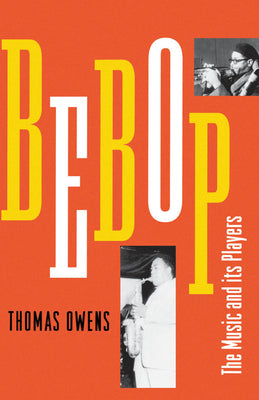
"When bebop was new," writes Thomas Owens, "many jazz musicians and most of the jazz audience heard it as radical, chaotic, bewildering music." For a nation swinging to the smoothly orchestrated sounds of the big bands, this revolutionary movement of the 1940s must have seemed destined for a short life on the musical fringe. But today, Owens writes, bebop is nothing less than "the lingua franca of jazz, serving as the principal musical language of thousands of jazz musicians."
In Bebop, Owens conducts us on an insightful, loving tour through the music, players, and recordings that changed American culture. Combining vivid portraits of bebop's gigantic personalities with deft musical analysis, he ranges from the early classics of modern jazz (starting with the 1943 Onyx Club performances of Dizzy Gillespie, Max Roach, Oscar Pettiford, Don Byas, and George Wallington) through the central role of Charlie Parker, to an instrument-by-instrument look at the key players and their innovations. Illustrating his discussion with numerous musical excerpts, Owens skillfully demonstrates why bebop was so revolutionary, with fascinating glimpses of the tempestuous jazz world: Thelonious Monk, for example, did "everything 'wrong' in the sense of traditional piano technique....Because his right elbow fanned outward away from his body, he often hit the keys at an angle rather than in parallel. Sometimes he hit a single key with more than one finger, and divided single-line melodies between two hands." In addition to his discussions of individual instruments and players, Owens examines ensembles, with their sometimes volatile collaborations: in the Jazz Messengers, Benny Golson told of how his own mellow saxophone playing would get lost under Art Blakey's furious drumming: "He would do one of those famous four-bar drum rolls going into the next chorus, and I would completely disappear. He would holler over at me, 'Get up out of that hole!'"
In this marvelous account, Owens comes right to the present day, with accounts of new musicians ranging from the Marsalis brothers to lesser-known masters like pianist Michel Petrucciani. Bebop is a jazz-lover's dream--a serious yet highly personal look at America's most distinctive music.
In Bebop, Owens conducts us on an insightful, loving tour through the music, players, and recordings that changed American culture. Combining vivid portraits of bebop's gigantic personalities with deft musical analysis, he ranges from the early classics of modern jazz (starting with the 1943 Onyx Club performances of Dizzy Gillespie, Max Roach, Oscar Pettiford, Don Byas, and George Wallington) through the central role of Charlie Parker, to an instrument-by-instrument look at the key players and their innovations. Illustrating his discussion with numerous musical excerpts, Owens skillfully demonstrates why bebop was so revolutionary, with fascinating glimpses of the tempestuous jazz world: Thelonious Monk, for example, did "everything 'wrong' in the sense of traditional piano technique....Because his right elbow fanned outward away from his body, he often hit the keys at an angle rather than in parallel. Sometimes he hit a single key with more than one finger, and divided single-line melodies between two hands." In addition to his discussions of individual instruments and players, Owens examines ensembles, with their sometimes volatile collaborations: in the Jazz Messengers, Benny Golson told of how his own mellow saxophone playing would get lost under Art Blakey's furious drumming: "He would do one of those famous four-bar drum rolls going into the next chorus, and I would completely disappear. He would holler over at me, 'Get up out of that hole!'"
In this marvelous account, Owens comes right to the present day, with accounts of new musicians ranging from the Marsalis brothers to lesser-known masters like pianist Michel Petrucciani. Bebop is a jazz-lover's dream--a serious yet highly personal look at America's most distinctive music.


